By Timothy Kitchen Jr
Everything living requires energy.
The human body cannot move without energy. The brain cannot think without energy. The heart cannot beat without energy. Every cell must receive, transform, and use energy continually for the purpose for which that cell was designed.
Yet there is something even greater that physical science cannot put beneath a microscope.
God is Spirit.
Jesus Christ said:
“God is a Spirit: and they that worship him must worship him in spirit and in truth.”
—John 4:24
And God gives His Holy Spirit to those who obey Him (Acts 5:32).
Herbert W. Armstrong frequently explained the Holy Spirit as the power of God—the power by which God creates, works, reveals truth, develops His character in human beings, and ultimately gives eternal life.
That introduces a profound question:
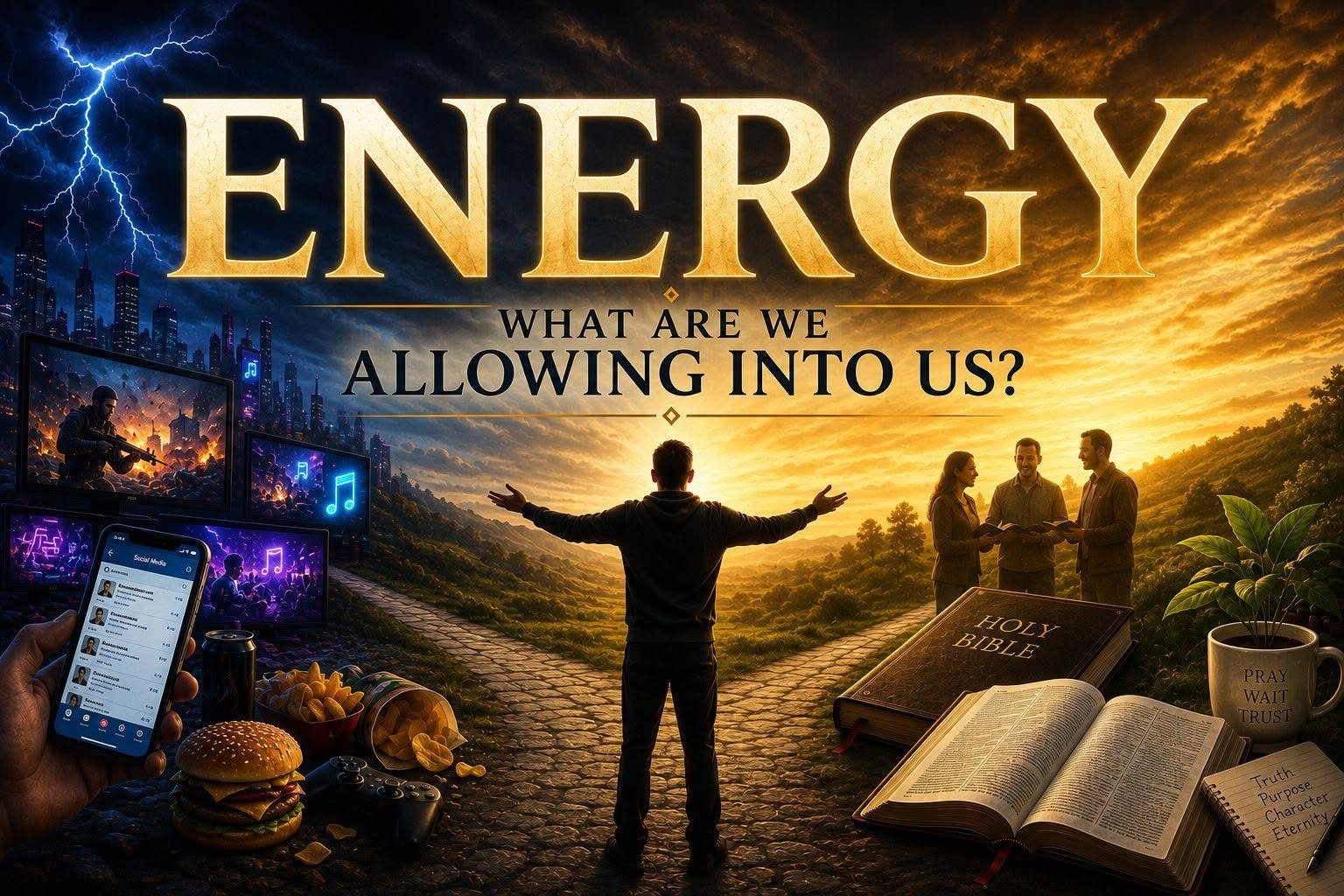
What kind of energy are we allowing into our lives?
Not merely electrical energy.
Not merely calories.
Not merely sound waves or light waves.
But everything entering the human being—physically, mentally and spiritually—and everything influencing what we think, desire, become and eventually produce.
God designed the human being with an intended purpose.
And perhaps we should think much more carefully about what we are putting into what God designed.
THE PHYSICAL BODY RUNS ON ENERGY
Science tells us something remarkable about food.
When we eat, the body does not simply store a hamburger, an apple or a piece of bread inside itself. Digestion breaks food down into usable components. Cells ultimately convert chemical energy into forms they can use for biological work.
One of the central molecules involved is ATP—adenosine triphosphate.
Muscles contracting, neurons functioning, cells maintaining their internal environment and countless other processes depend upon continual energy transformation.
The body therefore receives something from outside itself, processes it, and uses it internally.
The quality and nature of what enters matters.
That principle should immediately sound familiar to a Bible student.
God did not create the human body and then leave mankind completely ignorant about what should enter it.
He distinguished between clean and unclean animals.
Leviticus 11 and Deuteronomy 14 contain instructions concerning what was designed to be eaten and what was not.
The issue therefore reaches beyond the simplistic question:
Can I physically swallow it?
The better question is:
What was it intended for?
That word—purpose—becomes extremely important.
ENERGY ACCORDING TO PURPOSE
Human beings constantly discover that something can possess tremendous energy while nevertheless being used wrongly.
Fire can warm a house.
Fire can destroy a house.
Electricity can operate a hospital.
Electricity improperly directed can kill.
Food supplies chemical energy.
But not everything technically edible produces the same consequences in the human body.
Modern nutritional research increasingly illustrates this principle.
A major umbrella review examining nearly 10 million participants found that greater exposure to ultra-processed foods was associated with numerous adverse health outcomes, particularly cardiometabolic disease, common mental-health outcomes and mortality. Importantly, researchers also caution that the strength and quality of evidence varies among particular outcomes.
Science is therefore increasingly discovering something that should be intuitively obvious:
Input affects output.
What enters a system influences what that system becomes capable of producing.
Yet why should we apply this principle only to our stomach?
FIVE GATES INTO THE HUMAN MIND
God created human beings with physical senses.
We see.
We hear.
We smell.
We taste.
We touch.
Through these senses, enormous quantities of information continually enter the nervous system.
The eye receives light.
The ear receives vibrations.
Sensory receptors convert physical stimuli into neural signals.
The brain processes those signals, compares them with previous experiences and produces perceptions, thoughts, emotional responses and eventually behavior.
So when you watch something, something actually enters the human nervous system.
When you listen to something, something enters.
When somebody speaks to you, sound waves physically reach your ears and are transformed into neural activity.
We casually say:
“I am only watching it.”
“I am only listening to it.”
“It is only entertainment.”
But “only watching” is precisely how visual information gets into the brain.
And “only listening” is precisely how auditory information gets into the brain.
The five senses are not merely windows through which we look outward.
They are also gateways through which the world comes inward.
That makes Christ’s statement extraordinarily important:
“The light of the body is the eye: if therefore thine eye be single, thy whole body shall be full of light.”
—Matthew 6:22
What are we putting before our eyes?
What are we putting into our ears?
What atmosphere surrounds our homes?
What conversations continually surround our children?
What music fills our rooms?
What entertainment fills our evenings?
What preaching fills our minds?
What energy are we continually admitting through the gates God built into us?
“TAKE HEED WHAT YE HEAR”
Christ specifically warned:
“Take heed what ye hear…”
—Mark 4:24
Notice that carefully.
He did not merely tell His disciples to watch what they believed.
He told them to watch what they heard.
Why?
Because hearing comes before processing.
Input precedes response.
Paul likewise wrote:
“So then faith cometh by hearing, and hearing by the word of God.”
—Romans 10:17
Something enters.
Something is received.
Something begins producing something else.
God’s Word enters through hearing and understanding, and faith can develop from it.
The opposite principle must also be considered.
If truth continually entering the mind can influence us toward truth, what happens when lies continually enter?
If righteous examples influence us toward righteousness, what happens when unrighteousness becomes our constant entertainment?
Paul wrote:
“Be not deceived: evil communications corrupt good manners.”
—1 Corinthians 15:33
That is an ancient statement of input affecting output.
HUMAN BEINGS AFFECT ONE ANOTHER
Modern research into what psychologists call emotional contagion provides an interesting physical illustration.
Researchers have found that human beings can automatically mimic and synchronize facial expressions, vocalizations, posture and movements, sometimes producing convergence in emotional states. A recent scoping review examined 277 human-subject studies involving this phenomenon.
Other research has examined interpersonal synchrony—the tendency of people interacting together to develop temporal alignment in behavior and, under some conditions, physiological or neural activity.
Think about what that means.
Human beings were never designed as completely isolated biological machines.
We affect each other.
Expressions affect us.
Voices affect us.
Attitudes affect us.
Emotions affect us.
Words affect us.
Even mediated communication can influence emotional responses; research on emotional contagion has examined effects occurring without direct face-to-face contact.
The Bible told us long ago:
“He that walketh with wise men shall be wise: but a companion of fools shall be destroyed.”
—Proverbs 13:20
Why does companionship matter?
Because association is an exchange.
You are affecting them.
They are affecting you.
Something is passing between human beings—not necessarily some mysterious measurable spiritual radiation, but words, expressions, attitudes, examples, emotions, ideas and behaviors.
Scripture describes something still greater when God’s people assemble.
“WHERE TWO OR THREE ARE GATHERED”
Christ said:
“For where two or three are gathered together in my name, there am I in the midst of them.”
—Matthew 18:20
This should not be distorted into a scientific claim that researchers could place electrodes on two Christians and detect “God energy.”
God is Spirit.
The Holy Spirit is not simply another form of electromagnetic radiation waiting to be discovered.
But there is nevertheless an astonishing spiritual reality revealed here.
People can gather together—and God can be present among them.
That changes how we should think about fellowship.
Godly fellowship should not merely be people occupying the same room.
God must be there.
Truth must be there.
Love must be there.
God’s government must be there.
God’s purpose must be there.
Christ must be directing it.
Then fellowship becomes something far greater than social interaction.
WHAT DOES “HOLY” REALLY MEAN?
We often use “holy” merely to mean extremely good or morally clean.
But holiness fundamentally concerns that which is set apart to God.
Something holy belongs to God’s purpose.
God’s Sabbath is holy because God sanctified it.
God’s people are called holy because they are set apart to Him.
God’s Spirit is Holy Spirit because it proceeds from God and accomplishes God’s purpose.
Therefore, when discussing “holy entertainment,” we should be careful.
The question is not merely:
Does this contain profanity?
Something can contain no profanity whatsoever and still fill the mind with vanity, lust, violence, rebellion, selfishness or the spirit of this world.
A better question is:
Can God be present in this?
Would this strengthen the purpose for which God created the human mind?
Paul gives us an extraordinary filter:
“Whatsoever things are true, whatsoever things are honest, whatsoever things are just, whatsoever things are pure, whatsoever things are lovely, whatsoever things are of good report; if there be any virtue, and if there be any praise, think on these things.”
—Philippians 4:8
That is an input standard.
God tells us what deserves continuing access to the mind.
YOU CANNOT LIVE ON JUNK
Imagine someone saying:
“I eat every day. Therefore my diet must be healthy.”
Obviously that reasoning is ridiculous.
Eating is not enough.
What are you eating?
Likewise:
“I listen to sermons every Sabbath.”
That alone does not answer the question.
What are you hearing?
Christ warned repeatedly concerning false prophets.
Paul warned that men would arise:
“speaking perverse things, to draw away disciples after them.”
—Acts 20:30
Jeremiah condemned prophets who spoke visions from their own hearts rather than from the mouth of God (Jeremiah 23:16).
Therefore there can be spiritual junk food just as certainly as physical junk food.
Something may taste pleasant.
It may be packaged beautifully.
It may be easy to consume.
It may make us temporarily feel good.
But where did it come from?
And what does it produce?
Christ said:
“Ye shall know them by their fruits.”
—Matthew 7:16
Look at the output.
That reveals something about the input.
THE HOLY SPIRIT IS GOD’S POWER AT WORK
Christ told His disciples:
“But ye shall receive power, after that the Holy Ghost is come upon you…”
—Acts 1:8
The Greek word translated power is dynamis—power, ability, might.
Paul similarly wrote of God’s power:
“According to the working of his mighty power.”
—Ephesians 1:19
And again:
“For it is God which worketh in you both to will and to do of his good pleasure.”
—Philippians 2:13
Notice the language.
Power.
Working.
In you.
To do.
The Holy Spirit produces something.
It is not merely religious emotion.
It accomplishes God’s purpose.
Paul describes its fruit:
“But the fruit of the Spirit is love, joy, peace, longsuffering, gentleness, goodness, faith, meekness, temperance…”
—Galatians 5:22-23
Again we return to the same principle:
Look at the output.
God’s Spirit produces God’s fruit.
ANOTHER SPIRIT IS WORKING
But Scripture describes another influence operating within this world.
Paul calls Satan:
“the prince of the power of the air, the spirit that now worketh in the children of disobedience.”
—Ephesians 2:2
Notice again:
Spirit.
Worketh.
Influence producing behavior.
This does not mean Satan is literally broadcasting radio waves that science could measure with an antenna. Scripture is describing spiritual influence.
But the practical warning is enormous.
There are influences surrounding us.
Some draw toward God.
Others draw away from Him.
Therefore John commanded:
“Beloved, believe not every spirit, but try the spirits whether they are of God…”
—1 John 4:1
Test the source.
Test the purpose.
Test the fruit.
WHAT ARE YOU SURROUNDING YOURSELF WITH?
Consider your home.
Something is playing on the television.
Music is playing.
Someone is speaking.
Children are listening.
Phones are displaying images.
Conversations are occurring.
Food is being prepared.
Attitudes are being expressed.
Ideas are being repeated.
All day long, inputs are entering human beings.
And scientific research increasingly demonstrates that our social environments are not neutral. Humans respond physiologically, emotionally and behaviorally to other humans. Emotional synchronization and behavioral synchrony are measurable phenomena.
Scripture takes the principle much further:
“Make no friendship with an angry man; and with a furious man thou shalt not go:
Lest thou learn his ways, and get a snare to thy soul.”
—Proverbs 22:24-25
Notice the word learn.
Stay around anger long enough and something can be learned.
Stay around complaining long enough and complaining begins sounding normal.
Stay around profanity long enough and profanity stops shocking us.
Stay around sexual impurity long enough and impurity becomes entertainment.
Stay around rebellion long enough and authority becomes suspicious.
But the principle works positively as well.
Stay around faith.
Stay around gratitude.
Stay around service.
Stay around God’s Word.
Stay around people striving to obey God.
Listen to faithful teaching.
Sing godly music.
Discuss God’s truth around the dinner table.
Pray together.
Study together.
Keep God’s Sabbath together.
Create an environment in which God’s ways are normal.
THE FAMILY CREATES AN ENVIRONMENT
This makes God’s instructions concerning children especially meaningful.
“And thou shalt teach them diligently unto thy children, and shalt talk of them when thou sittest in thine house, and when thou walkest by the way, and when thou liest down, and when thou risest up.”
—Deuteronomy 6:7
Look at the environment God describes.
Morning.
Evening.
Home.
Travel.
Conversation.
Daily life.
God did not intend His way to enter a child’s mind for merely two hours during a weekly church service.
He intended children to live inside an environment saturated with God’s way.
Not forced religiosity.
Not constant preaching at children.
A way of life.
They should see God’s government working.
Hear prayer.
Experience love.
Watch forgiveness.
Observe their father and mother obey God.
Hear God’s Word discussed naturally.
Experience the Sabbath as something wonderful.
That becomes the environment feeding the developing mind.
“BE YE FILLED WITH THE SPIRIT”
Paul wrote:
“And be not drunk with wine, wherein is excess; but be filled with the Spirit.”
—Ephesians 5:18
Filled.
That is fascinating terminology.
Something occupies us.
Something influences us.
Something moves us.
And Paul contrasts one influence with another.
What fills the mind?
What fills the home?
What fills our conversation?
What fills our entertainment?
What fills our stomach?
What fills our eyes?
What fills our ears?
And ultimately:
What fills us spiritually?
GOD’S WAY IS THE WAY OF GIVE
Herbert W. Armstrong repeatedly contrasted God’s way of GIVE with Satan’s way of GET.
That distinction is extremely useful here.
God’s Spirit does not merely provide power.
It produces God’s nature and God’s way.
God gives.
God creates.
God sustains.
God serves.
God loves.
God’s spiritual power therefore operates according to God’s character and purpose.
Energy without right direction can destroy.
Power without character is dangerous.
Knowledge without love can puff up.
Therefore God’s ultimate objective is not merely to give human beings tremendous power.
It is to first develop within them His holy, righteous character.
Only then can enormous power be entrusted safely.
GOD IS THE SOURCE
Ultimately, everything points backward toward a Source.
Physical creation contains energy because God created a universe capable of functioning according to laws He established.
Our bodies transform chemical energy because God designed them that way.
Our senses receive information because God designed them that way.
Our minds process information because God designed them that way.
Human beings influence one another because God created us as relational beings.
But none of those physical processes are God.
Creation is not the Creator.
God transcends the physical creation.
And God’s Holy Spirit represents something science cannot manufacture in a laboratory:
God working in man.
Paul wrote:
“Know ye not that ye are the temple of God, and that the Spirit of God dwelleth in you?”
—1 Corinthians 3:16
Think about that.
The human body receives physical nourishment.
The human mind receives sensory information.
But the converted human being can receive something infinitely greater:
the Spirit of God.
GUARD THE TEMPLE
If God’s Spirit dwells within us, then perhaps we should think much more carefully about the environment we construct around that temple.
Paul wrote:
“What? know ye not that your body is the temple of the Holy Ghost which is in you…?”
—1 Corinthians 6:19
Then what are we feeding that body?
What are we feeding that mind?
What are we watching?
What are we listening to?
Whom are we following?
Whose sermons are shaping our understanding?
Whose attitudes continually surround us?
What occupies our homes?
What enters through our five senses?
Because input eventually produces output.
Christ gave the ultimate test:
“Wherefore by their fruits ye shall know them.”
—Matthew 7:20
Good energy directed according to God’s intended purpose should produce good fruit.
Good food should nourish the body.
Good teaching should nourish the mind.
Godly fellowship should strengthen the brethren.
Godly music should direct the emotions upward.
Godly entertainment should leave the mind cleaner rather than dirtier.
God’s ministers should feed God’s flock.
And God’s Holy Spirit should produce God’s character.
TRY THE SPIRITS
We therefore need to begin asking questions we may not normally ask.
Where did this come from?
What is its intended purpose?
What is entering me?
What is it producing in me?
Does it draw me toward God or away from Him?
Can God be present in this?
Those questions can be asked about food.
Entertainment.
Music.
Friendships.
Social media.
Church fellowship.
Sermons.
Education.
Family life.
Conversation.
Even our own thoughts.
Paul wrote:
“Prove all things; hold fast that which is good.”
—1 Thessalonians 5:21
And John wrote:
“Try the spirits whether they are of God.”
—1 John 4:1
God does not command us simply to absorb everything surrounding us.
Test it.
Determine the source.
Determine the purpose.
Examine the fruit.
WHAT ENERGY ARE YOU ALLOWING IN?
The physical creation teaches us a principle.
Energy received is transformed into action.
Food becomes usable cellular energy.
Light entering the eye becomes neural information.
Sound entering the ear becomes neural information.
Human interaction can alter emotion, attention and even measurable physiological responses. Science continues to investigate how profoundly our environment and relationships affect us.
But Scripture reveals the dimension science cannot reach.
There is spiritual influence.
There is God’s Spirit.
There is the spirit of this world.
And there is a human mind standing between them, continually making choices about what it will receive, entertain, believe and obey.
That makes Paul’s instruction extraordinarily serious:
“Set your affection on things above, not on things on the earth.”
—Colossians 3:2
And:
“Let this mind be in you, which was also in Christ Jesus.”
—Philippians 2:5
God wants His mind, His character, His way and His Spirit working within us.
So guard the gates.
Guard your eyes.
Guard your ears.
Guard your mouth.
Guard your associations.
Guard what enters your home.
Guard what your children continually absorb.
Guard what ministers you allow to teach you.
Guard what you call entertainment.
Guard what you put into the body God created.
And above everything else, continually seek the Spirit that comes from God.
Because the ultimate question is not simply whether something contains energy.
Everything around us involves energy in one physical sense or another.
The question is:
Where does it come from?
What is its purpose?
Where is it taking us?
What fruit is it producing?
And—
Is God in it?
“For in him we live, and move, and have our being…”
—Acts 17:28
God created life.
God established its purpose.
God reveals how that life should be lived.
And through His Holy Spirit, God is accomplishing the greatest transformation imaginable—not merely transferring physical energy, but transforming human beings until they reflect the very holy, righteous character of God.
Leave a Reply