By Timothy Kitchen Jr
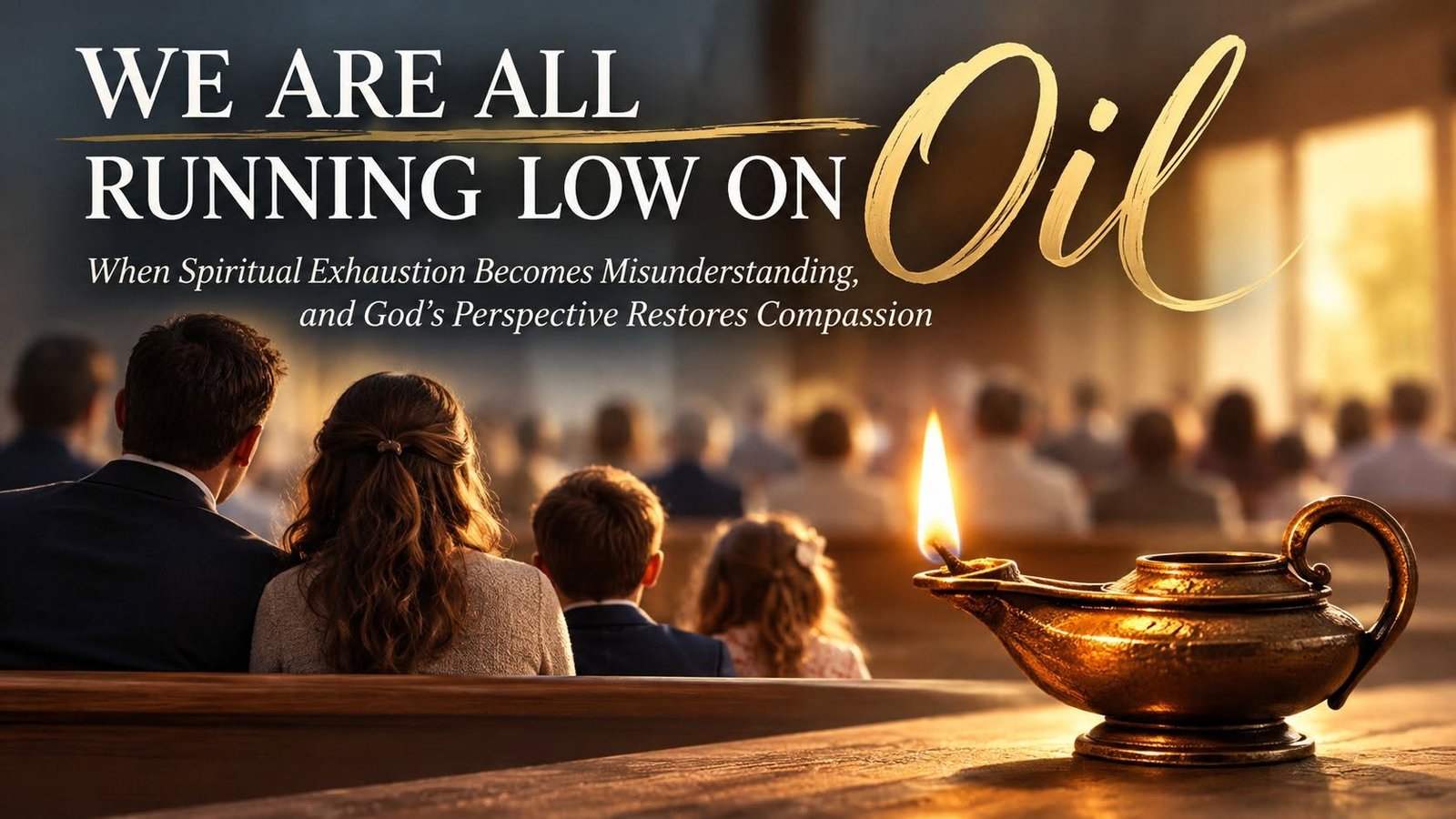
When Spiritual Exhaustion Becomes Misunderstanding, and God’s Perspective Restores Compassion
There is a kind of exhaustion that sleep cannot remedy.
A husband and wife get their children ready for Sabbath services. They have spent the week working, providing, worrying, praying, and trying to hold everything together. Perhaps they have been struggling financially. Perhaps they have been dealing with illness, uncertainty, disappointment, or circumstances that seem to have no immediate resolution.
They are tired.
Not merely physically tired.
They are spiritually drained.
But they get dressed, gather their children, and go to services.
Why?
Because they are seeking God.
They are seeking fellowship, encouragement, instruction, and the spiritual strength necessary to face another week.
They are hoping to be refueled.
Yet something happens when they walk into the room.
There are people everywhere. Conversations taking place. Families greeting one another. Brethren moving from one conversation to another.
And somehow, in a room filled with God’s people, they feel completely alone.
They sit down, perhaps exchange a few greetings, and quietly wonder:
Does anybody see us?
Does anybody know what we’re going through?
Does anybody care?
And then something dangerous can happen.
An interpretation begins to take shape before the facts are known.
WHEN SATAN FINDS AN OPENING
Satan is called the accuser of our brethren.
Revelation 12:10 describes him as the one who accuses God’s people before God day and night.
But accusation does not always begin with an outspoken charge.
Sometimes it begins with a suggestion.
They’re ignoring you.
They don’t want you here.
They saw you walk in and turned away.
If they really loved you, they would have come over.
You don’t belong here.
Notice something about these thoughts.
They assign intentions to other people without actually knowing those intentions.
Someone may have walked past without speaking.
That is an observation.
But concluding that the person walked past because they dislike us is an interpretation.
And when we are already spiritually exhausted, that interpretation can feel overwhelmingly convincing.
The feelings are real.
The loneliness is real.
The hurt may be very real.
But just because something feels a certain way does not mean our interpretation of it is the truth.
Satan can exploit that difference.
He can take an exhausted mind, a wounded heart, and an ordinary interaction and encourage us to see rejection where rejection may never have existed.
And suddenly, instead of seeing our brethren as fellow members of God’s family, we begin seeing them through suspicion.
That is when we need to stop and seek God’s perspective.
WHAT IF EVERYONE ELSE IS JUST AS TIRED?
Consider something.
What if there are a hundred people gathered for Sabbath services, and many of them are experiencing the very same exhaustion?
What if the man who walked past without speaking has been working long hours, struggling to provide for his family?
What if the woman who seemed distant has spent the week caring for a sick child?
What if the elderly member sitting quietly has been struggling with loneliness for months?
What if the family who left immediately after services was simply overwhelmed?
What if the person whose greeting seemed cold was doing everything possible just to make it through the day?
And what if the very person we thought was ignoring us went home wondering why nobody seemed interested in speaking with them?
Think about that.
Two people can stand beside one another, both feeling rejected, while neither one intends to reject the other.
One is waiting for the other to show concern.
The other is waiting for exactly the same thing.
Both are hurting.
Both are tired.
Both are looking for encouragement.
And both may mistakenly conclude that the other doesn’t care.
Meanwhile, Satan has an opportunity to turn shared suffering into mutual suspicion.
We are all in the same boat.
Some are rowing harder than others.
Some are barely holding an oar.
Some are taking on water.
And some are so exhausted that they cannot see the person beside them struggling with the very same thing.
Yet we are still in the same boat.
WHEN OUR OIL IS RUNNING LOW
In Matthew 25:1–13, Jesus Christ gives the parable of the ten virgins.
All ten were waiting for the bridegroom.
All ten had lamps.
And all ten became weary and slept.
But there was a difference.
Five had prepared with oil, and five had not.
There is a profound spiritual lesson here concerning readiness, endurance, and the necessity of maintaining our spiritual supply.
Consider how this applies to our lives.
When we are spiritually strong, it can be easier to exercise patience.
It can be easier to overlook an awkward interaction.
It can be easier to approach someone with warmth, even when they seem distant.
But when we are spiritually depleted, everything becomes more difficult.
Our patience grows thin.
Our perspective narrows.
Our emotions become more easily disturbed.
We may become so consumed with our own difficulties that we cannot recognize the difficulties of others.
And sometimes, without intending to, we begin giving off the very coldness that we believe we are receiving.
We feel neglected, so we withdraw.
Others perceive our withdrawal as disinterest, so they withdraw.
And the cycle continues.
But what if the underlying problem is not a lack of love?
What if many of us are simply running low on oil?
Not everyone is at the same level.
Some have been spiritually renewed and strengthened. Others are struggling to keep their lamps burning.
But when spiritual exhaustion becomes widespread, shouldn’t that cause us to ask a much larger question?
Why are so many of us running low?
THE FEAST BLAHS — OR SOMETHING DEEPER?
There is an expression sometimes used after the Feast of Tabernacles.
“The Feast blahs.”
After eight days of rejoicing, fellowship, spiritual instruction, and focusing on God’s coming Kingdom, we return to our ordinary responsibilities.
Work resumes.
Bills remain.
Physical problems have not necessarily disappeared.
The difficulties we temporarily stepped away from are still waiting.
And sometimes the contrast is overwhelming.
But perhaps we should examine this more carefully.
Is what we are experiencing merely the emotional letdown following the Feast?
Or does returning to our regular lives reveal just how spiritually exhausted we have become?
The Feast is intended to strengthen our vision of God’s Kingdom.
It gives us an opportunity to rejoice before Him and experience a foretaste of the world He is preparing.
But the spiritual strength we need cannot be sustained merely by remembering how wonderful the Feast felt.
We need God’s Spirit continually.
We need prayer.
We need study.
We need repentance.
We need to remain close to God.
And we need one another.
Hebrews 10:24–25 tells us:
“And let us consider one another to provoke unto love and to good works: Not forsaking the assembling of ourselves together, as the manner of some is; but exhorting one another: and so much the more, as ye see the day approaching.”
Notice the instruction.
Consider one another.
That requires more than simply being in the same room.
It requires thinking about the condition of the person beside us.
And sometimes, that means recognizing that the person who seems cold may be the very person who needs encouragement most.
SOMETHING GOD SHOWED ME
I want to share something personal.
Over the past few months, I have experienced this very thing.
I have walked into services feeling spiritually drained.
I have felt alone in a crowd.
I have wondered why certain people didn’t speak, why conversations seemed distant, and why the warmth I was hoping to experience seemed absent.
And I began taking it personally.
Did I do something?
Have I offended someone?
Am I not wanted here?
Those questions began shaping how I perceived the people around me.
And I had to confront something about myself.
I was allowing my feelings to influence my conclusions about others.
I was interpreting what I saw through the exhaustion and hurt I was carrying.
So I went to God.
I asked Him to show me why I was feeling this way.
I wanted to understand what was happening.
And as I began looking beyond my own circumstances, I came to see something from a different perspective.
We are all running low on oil.
Not necessarily to the same degree.
Not for the same reasons.
But so many of us are tired.
So many are struggling.
So many are carrying burdens that others cannot see.
And here I was, looking at the behavior of others and interpreting it as something directed toward me.
I had allowed room for accusation.
And I had to repent of that.
Because I cannot know what is in another person’s heart simply by observing their outward behavior.
I cannot conclude that someone doesn’t care because they failed to express concern in the way I expected.
And I cannot allow Satan to turn my personal exhaustion into accusations against my brethren.
That doesn’t mean every concern is imaginary.
Sometimes there are genuine problems that need to be addressed.
Sometimes people really are overlooked.
Sometimes love does grow cold.
But even then, God requires us to approach matters according to truth, not assumption.
And I had to recognize the difference.
WHAT IF WE STEPPED INTO THEIR SHOES?
Philippians 2:4 tells us:
“Look not every man on his own things, but every man also on the things of others.”
Consider what would happen if we began practicing this more deliberately.
Instead of asking why someone didn’t greet us, perhaps we could ask whether they are doing all right.
Instead of assuming someone is distant because they dislike us, perhaps we could consider whether they are carrying something heavy.
Instead of waiting for someone to show us compassion, perhaps we could ask God to help us show compassion first.
But there is something even more important.
We should not stop at trying to see things from another person’s perspective.
We must seek God’s perspective.
Our human empathy is limited.
We naturally interpret circumstances through our own experiences, emotions, and understanding.
And sometimes those things mislead us.
God sees what we cannot.
He knows the heart.
He knows the burdens.
He knows the trials.
He knows what each person has endured just to be present.
And He knows what each person needs.
That is why we must ask Him to guide our understanding.
We should not merely attempt to manufacture warm feelings toward others.
We should seek the Spirit of God, allowing His love to work in us.
Romans 5:5 says:
“Because the love of God is shed abroad in our hearts by the Holy Ghost which is given unto us.”
That love does not originate in our human emotions.
It comes from God.
And when we are being led by His Spirit, compassion becomes something greater than simply feeling sorry for another person.
It becomes outgoing concern.
It becomes patience.
It becomes mercy.
It becomes a willingness to act.
WHEN SOMEONE TELLS US THEY ARE LONELY
There is another side to this.
Suppose someone approaches us and says:
I feel alone.
I feel like nobody wants me here.
I feel like I’m being ignored.
What should our response be?
We could immediately defend ourselves.
We could explain that nobody intended to make them feel that way.
We could tell them they are taking things too personally.
And perhaps, in some cases, their interpretation really is mistaken.
But is correcting their interpretation the first thing they need?
Or should we first recognize that someone has just told us they are hurting?
Galatians 6:2 says:
“Bear ye one another’s burdens, and so fulfil the law of Christ.”
If someone tells us they are lonely, we have been given an opportunity to bear a burden.
We don’t have to agree with every conclusion they have drawn.
We don’t have to assume someone else has done something wrong.
But we can listen.
We can care.
We can pray.
And perhaps we can ask God to show us what that person needs.
Sometimes the greatest expression of compassion is simply taking the time to understand.
And sometimes the person who is hurting also needs to ask God to help them understand the people around them.
Compassion must work in both directions.
The exhausted person needs understanding.
And the exhausted person must also seek to understand.
ARE WE DRAWING FROM THE RIGHT SOURCE?
There is a danger in trying to sustain spiritual fellowship entirely through human emotion.
We want to feel welcomed.
We want to feel appreciated.
We want to feel loved.
Those are understandable desires.
But if our spiritual stability depends upon how warmly others greet us, how frequently they contact us, or how much attention we receive, then our peace becomes dependent upon circumstances we cannot control.
We must draw from something deeper.
Jesus Christ said in John 7:37–39:
“If any man thirst, let him come unto me, and drink.”
He then spoke of living water, which John explains referred to the Spirit.
Notice where the thirsty are directed.
To Christ.
Not merely to the emotional reassurance of other people.
Certainly, God uses His people to encourage and strengthen one another.
But the source of spiritual life is God.
And if we are all attempting to draw strength from one another while neglecting the Source, eventually we will all become exhausted.
We cannot continually pour out what we are not receiving.
We need to return to God.
Not simply to feel better.
But to be changed.
To have our perspective corrected.
To have our love renewed.
To have our minds brought back into harmony with His.
SATAN ACCUSES. GOD’S SPIRIT PRODUCES LOVE.
There is a striking contrast between accusation and compassion.
Accusation takes an observation and assigns guilt.
Compassion takes an observation and seeks understanding.
Accusation asks:
What is wrong with that person?
Compassion asks:
What might that person be going through?
Accusation assumes the worst.
Compassion seeks the truth.
And the Spirit of God produces a very different fruit from suspicion and resentment.
Galatians 5:22–23 says:
“But the fruit of the Spirit is love, joy, peace, longsuffering, gentleness, goodness, faith, Meekness, temperance: against such there is no law.”
These are not merely pleasant feelings.
They are qualities produced through God’s Spirit working in us.
When we are spiritually exhausted, we especially need those qualities.
When our feelings are hurt, we need longsuffering.
When we are tempted to assume the worst, we need meekness and patience.
When we feel alone, we need faith.
And when we see another person struggling, we need love.
Not love manufactured by human reasoning.
Not compassion that exists only when we feel emotionally comfortable.
But the love of God working through us.
WE ARE NOT EACH OTHER’S ENEMY
Ephesians 6:12 reminds us:
“For we wrestle not against flesh and blood, but against principalities, against powers, against the rulers of the darkness of this world, against spiritual wickedness in high places.”
Our brethren are not the enemy.
The exhausted husband is not the enemy.
The overwhelmed wife is not the enemy.
The elderly member sitting quietly is not the enemy.
The person who didn’t greet us is not automatically the enemy.
We are members of the same spiritual family.
And we are all engaged in a spiritual battle.
Some are stronger today.
Some are weaker.
Some are rejoicing.
Some are barely hanging on.
But we are not supposed to turn upon one another because our individual struggles have made us weary.
We are supposed to strengthen one another.
James 5:16 tells us to pray for one another.
First Thessalonians 5:11 tells us to comfort and edify one another.
Romans 12:15 tells us to rejoice with those who rejoice and weep with those who weep.
And First Corinthians 12:26 says:
“And whether one member suffer, all the members suffer with it; or one member be honoured, all the members rejoice with it.”
That is the perspective we need.
Not merely my suffering.
Not merely my loneliness.
Not merely my exhaustion.
But our suffering, our struggles, and our shared need for God’s Spirit.
PERHAPS WE SHOULD ALL ASK WHY
If one person is spiritually exhausted, there may be circumstances particular to that individual.
But when many people are spiritually exhausted, shouldn’t we begin asking broader questions?
Are we spending enough time with God?
Are we nourishing ourselves with His Word?
Are we allowing the cares of this life to consume our attention?
Are we praying for one another?
Are we actually considering one another?
Are we approaching fellowship expecting only to receive, or are we also seeking opportunities to give?
And are we allowing our exhaustion to shape how we interpret the actions of others?
These questions are not intended to accuse anyone.
They are questions I believe we should be willing to ask ourselves.
I had to ask them of myself.
And I didn’t particularly like everything I discovered.
But repentance requires us to be willing to see what God shows us.
Even when what He shows us concerns our own thinking.
LET COMPASSION COME FROM GOD
I began this by describing a husband, wife, and family walking into Sabbath services spiritually exhausted.
They came seeking God.
They came hoping to be strengthened.
And they found themselves feeling alone.
But perhaps the most important thing they needed to discover was that they were not the only ones feeling that way.
Perhaps the room was filled with people who were also tired.
People who were also hurting.
People who were also waiting for someone to show concern.
And perhaps what looked like coldness was, in many cases, exhaustion.
What looked like rejection was distraction.
What looked like indifference was another person struggling to remain standing.
That does not mean we should dismiss loneliness or overlook genuine failures to show love.
It means we should seek understanding before forming conclusions.
We should pray for one another.
We should reach out to one another.
We should bear one another’s burdens.
And above all, we should go to God.
Because the answer is not simply for everyone to try harder to appear friendly.
The answer is for us to draw closer to the One from whom genuine love flows.
We need His Spirit.
We need His perspective.
We need His compassion.
And we need to recognize that our feelings, however powerful, are not always reliable witnesses to another person’s intentions.
I learned that personally.
I allowed myself to take things personally.
I allowed suspicion to enter my thinking.
And I had to repent.
But in seeking God, I began to see something beyond my own hurt.
I began to see a room full of people who might be struggling just as much as I was.
And that changed how I looked at them.
Instead of wondering why they weren’t showing me love, I began asking God to help me love them.
Perhaps that is where healing begins.
Not by demanding that everyone else refill our lamps.
Not by assuming that every tired face is a sign of rejection.
But by returning to God, seeking His Spirit, and allowing His love to flow through us toward one another.
Because we are all in the same boat.
And many of us are running low on oil.
So let us pray for one another.
Let us strengthen the hands that hang down.
Let us consider the burdens we cannot see.
And when we are tempted to believe the worst about someone, let us first ask God to show us what we may be missing.
Let our compassion come from God.
Let our understanding come from God.
Let our love come from God.
And let our perspective be shaped by His Spirit rather than by our own exhaustion.
For sometimes the person we believe has turned away from us is simply another weary member of God’s family, praying for the very same strength we are seeking.
And perhaps, through God’s Spirit, we can become an answer to one another’s prayers.
“Wherefore lift up the hands which hang down, and the feeble knees.”
Hebrews 12:12
Leave a Reply