By Timothy Kitchen Jr
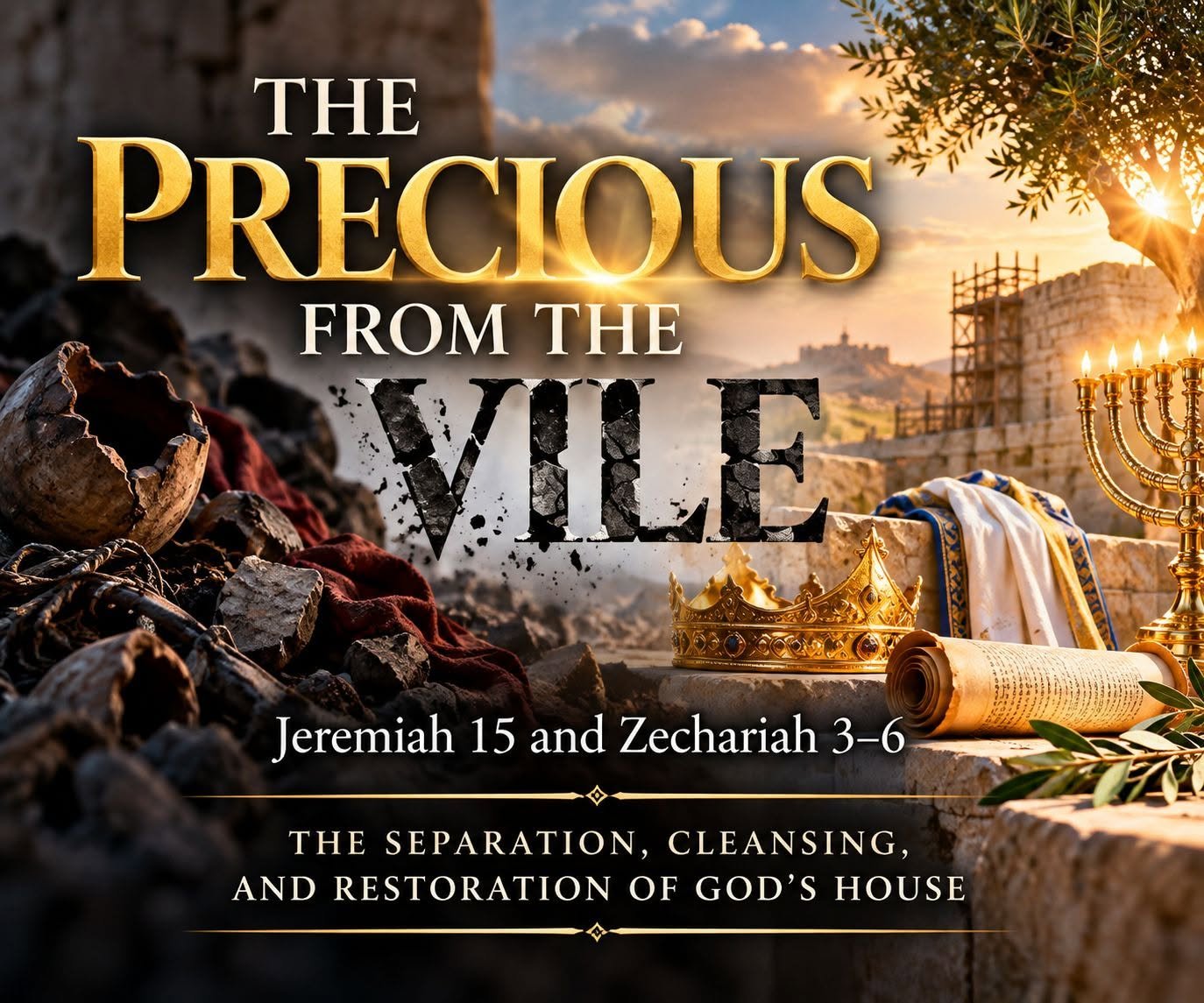
Jeremiah 15 and Zechariah 3–6: The Separation, Cleansing, and Restoration of God’s House
Introduction: God Is Not Building With Everything That Comes Before Him
Throughout the Scriptures, God reveals a consistent pattern in His dealings with His people.
He calls. He separates. He corrects. He cleanses. He establishes.
And when His people have departed from His ways, He calls them to return.
But returning to God does not mean bringing everything accumulated during a period of spiritual displacement back into His House.
There must first be a separation.
There must be a distinction between what is precious and what is vile, between what God has established and what man has introduced, between the things that proceed from God and those that originate in human reasoning.
This principle is powerfully expressed in Jeremiah 15 and illustrated through the prophetic visions of Zechariah chapters 3 through 6.
Jeremiah reveals the condition required of one who would stand before God and speak His words.
Zechariah reveals the cleansing, restoration, and establishment of God’s House under His authority.
Together, these passages present a profound picture of spiritual restoration.
And at the center of both stands a single requirement:
We must return to God. We must not expect God to return to us on our own terms.
1. Jeremiah 15: A People Who Would Not Return
Jeremiah ministered during a time when Judah had departed from God.
The people possessed the history of God’s dealings with Israel. They possessed the law, the priesthood, and the temple.
Yet possessing these things did not mean they were walking faithfully before Him.
God declared:
“Thou hast forsaken me, saith the LORD, thou art gone backward: therefore will I stretch out my hand against thee, and destroy thee; I am weary with repenting.”
— Jeremiah 15:6
Notice the direction of movement.
They had gone backward.
They had departed from the position in which God had placed them.
Their displacement was spiritual before it became physical.
The destruction of Jerusalem and the captivity of Judah were not merely political events. They were consequences of a people departing from the government and commandments of God.
Yet within this troubled nation stood Jeremiah.
He was not exempt from suffering.
He experienced rejection, opposition, loneliness, and anguish.
He was called to speak God’s words among people who often did not wish to hear them.
And in Jeremiah 15, we find that even God’s servant needed correction.
This is important.
Being called to speak God’s words does not place a man beyond the need for personal correction.
God was not merely addressing the nation through Jeremiah. He was also dealing with Jeremiah himself.
2. The Words of God Must First Be Received
Jeremiah declared:
“Thy words were found, and I did eat them; and thy word was unto me the joy and rejoicing of mine heart: for I am called by thy name, O LORD God of hosts.”
— Jeremiah 15:16
Before Jeremiah could faithfully speak God’s words, he had to receive them.
He did not merely hear them.
He ate them.
They became part of him.
This is a spiritual principle extending far beyond Jeremiah’s lifetime.
God’s truth is not something we simply repeat with our mouths while remaining unchanged within.
It must enter the heart.
It must govern our thinking.
It must correct our conduct.
It must replace our natural reasoning with the mind and judgment God reveals through His Word.
This brings us directly to Zechariah 3.
Joshua the high priest is standing before the angel of the LORD.
But something is wrong.
He is clothed in filthy garments.
The office is present. The man is standing there. Yet his condition requires cleansing.
The outward position does not eliminate the inward need.
Just as Jeremiah must receive correction before faithfully representing God’s words, Joshua must be cleansed before proceeding in the responsibilities placed before him.
God does not merely restore a position. He addresses the condition of the one occupying it.
3. Jeremiah 15:19 — The Great Principle of Restoration
One of the most significant statements in Jeremiah 15 is found in verse 19.
“Therefore thus saith the LORD, If thou return, then will I bring thee again, and thou shalt stand before me: and if thou take forth the precious from the vile, thou shalt be as my mouth: let them return unto thee; but return not thou unto them.”
— Jeremiah 15:19
Consider the order of this instruction.
First:
“If thou return.”
Even Jeremiah, God’s prophet, was instructed to return.
God did not tell Jeremiah to establish his own position.
He did not tell him to justify every feeling or reaction.
He told him to return.
Second:
“Then will I bring thee again, and thou shalt stand before me.”
The standing comes from God.
It is God who restores the servant to his proper position.
Third:
“If thou take forth the precious from the vile, thou shalt be as my mouth.”
There must be discernment.
The precious must be distinguished from the vile.
The words of God must not be confused with the emotions, frustrations, assumptions, or reasoning of man.
This instruction applies first to Jeremiah’s own speech and conduct. It also establishes a broader principle for those who would faithfully communicate God’s truth.
Fourth:
“Let them return unto thee; but return not thou unto them.”
Here is a remarkable statement concerning direction.
God’s servant was not to abandon God’s instruction in order to accommodate those who opposed it.
The movement was to be toward God, not away from Him.
This principle connects directly with the restoration described in Zechariah.
The restoration of God’s House does not begin with God adopting the ways of those who have departed.
It begins with a return to His established order.
4. Zechariah 3: The Removal of Filthy Garments
Zechariah writes:
“And he shewed me Joshua the high priest standing before the angel of the LORD, and Satan standing at his right hand to resist him.”
— Zechariah 3:1
Here we see Joshua standing before God while Satan stands to oppose him.
Joshua is not presented as a man who has already attained perfection.
His garments are filthy.
“Now Joshua was clothed with filthy garments, and stood before the angel.”
— Zechariah 3:3
But notice what happens next.
“And he answered and spake unto those that stood before him, saying, Take away the filthy garments from him. And unto him he said, Behold, I have caused thine iniquity to pass from thee, and I will clothe thee with change of raiment.”
— Zechariah 3:4
The cleansing comes by God’s command.
Joshua does not cleanse himself through the authority of his office.
Neither does he establish his righteousness by pointing to his position.
God removes the filthy garments.
God causes the iniquity to pass.
God provides the change of raiment.
Here we see a beautiful connection with Jeremiah 15:19.
Jeremiah is told to return so that God may restore his standing.
Joshua is shown receiving cleansing so that he may properly fulfill the responsibilities associated with his standing.
Both passages demonstrate that standing before God requires submission to God’s correction.
The garments must be changed.
The precious must be separated from the vile.
And what does God tell Joshua after the cleansing?
“Thus saith the LORD of hosts; If thou wilt walk in my ways, and if thou wilt keep my charge, then thou shalt also judge my house, and shalt also keep my courts, and I will give thee places to walk among these that stand by.”
— Zechariah 3:7
Notice the conditional language.
“If thou wilt walk in my ways.”
“If thou wilt keep my charge.”
Then comes the responsibility of judging God’s House and keeping His courts.
The authority is not presented as independent of obedience.
It is connected to faithfulness.
This is the same essential principle revealed to Jeremiah.
Return.
Separate the precious from the vile.
Stand before God.
Walk in His ways.
Keep His charge.
5. The Brand Plucked Out of the Fire
In Zechariah 3:2, God declares:
“Is not this a brand plucked out of the fire?”
This is a striking description.
A brand is a piece of wood that has been exposed to the fire.
It bears the evidence of danger.
It has been brought near destruction.
Yet it has been removed.
Joshua’s standing is therefore not a testimony to his own ability to preserve himself.
It is a testimony to God’s intervention.
Consider the historical setting.
The people had returned from Babylonian captivity.
Jerusalem had suffered destruction.
The temple had been destroyed.
The nation had experienced the consequences of departing from God.
Yet God had preserved a remnant.
He had brought them back.
Now the work of restoration was underway.
Jeremiah had warned of judgment and captivity.
Zechariah was encouraging the returned community during the rebuilding of the temple.
These are different historical moments, but they are connected by the same divine purpose.
God corrects His people, yet He also opens the way for repentance and restoration.
He does not preserve the remnant merely so they can continue in the practices that contributed to their displacement.
He brings them back to establish what He has commanded.
6. Zechariah 4: Not by Might, Nor by Power
The next vision introduces another essential element.
Zechariah sees a golden candlestick, a bowl, seven lamps, and two olive trees.
The explanation includes one of the most important statements in the chapter:
“Not by might, nor by power, but by my spirit, saith the LORD of hosts.”
— Zechariah 4:6
This word is addressed to Zerubbabel.
Zerubbabel was responsible for the rebuilding work.
Yet the accomplishment of God’s purpose would not depend ultimately upon human strength, political influence, material wealth, or personal ability.
It would be accomplished through God’s Spirit.
Now return to Jeremiah 15.
Jeremiah had suffered opposition and exhaustion.
He had felt the weight of his calling.
But God did not instruct him to overcome through human force.
Instead, God called him to return, distinguish the precious from the vile, and faithfully stand before Him.
God then promised:
“And I will make thee unto this people a fenced brasen wall: and they shall fight against thee, but they shall not prevail against thee: for I am with thee to save thee and to deliver thee, saith the LORD.”
— Jeremiah 15:20
Jeremiah’s strength would come from God.
Zerubbabel’s success would come through God’s Spirit.
Joshua’s cleansing would come through God’s intervention.
Three different responsibilities.
One divine source.
God supplies what man cannot produce of himself.
This is especially important when considering the restoration of God’s Church.
A spiritual work cannot be accomplished merely by reproducing an outward organization.
Neither can it be accomplished by human determination alone.
The work must be directed by God, sustained through His Spirit, and governed by His Word.
7. Joshua and Zerubbabel: Spiritual Cleansing and Physical Building
Zechariah chapters 3 and 4 present Joshua and Zerubbabel in complementary responsibilities.
Joshua represents the priestly responsibility.
Zerubbabel represents the governing and rebuilding responsibility.
Joshua’s garments must be cleansed.
Zerubbabel’s hands must complete the building.
“The hands of Zerubbabel have laid the foundation of this house; his hands shall also finish it.”
— Zechariah 4:9
Notice that God identifies the foundation and the completion.
The work has an appointed beginning and an intended end.
It is not a project that can be continually redefined according to the preferences of those who become involved.
The building belongs to God.
The purpose belongs to God.
The instructions belong to God.
Now consider Jeremiah 15:19 again:
“Let them return unto thee; but return not thou unto them.”
There is a connection here.
If Zerubbabel were to abandon the foundation God had appointed and build according to every competing proposal, would he be faithfully completing the work assigned to him?
If Joshua were to preserve the filthy garments rather than receive the change God commanded, would he be prepared to keep God’s courts?
And if Jeremiah were to replace God’s words with what the people preferred to hear, would he remain faithful to his calling?
The answer in each case follows the same principle.
God’s work must be accomplished God’s way.
However, this does not mean every personal interpretation, organizational custom, or claim of authority automatically represents God’s way.
The precious must still be distinguished from the vile by the standard of God’s revealed Word.
That requirement applies to everyone.
8. Zechariah 5: What Cannot Remain in God’s House
Zechariah 5 introduces two remarkable visions.
First comes the flying roll.
It represents a curse going forth against wrongdoing, specifically including stealing and false swearing.
“I will bring it forth, saith the LORD of hosts, and it shall enter into the house of the thief, and into the house of him that sweareth falsely by my name.”
— Zechariah 5:4
Notice that God’s restoration includes judgment upon wrongdoing.
Building a house for God does not mean ignoring what is contrary to His law.
Then comes the vision of the ephah.
Within it is a woman identified as Wickedness.
“And he said, This is wickedness. And he cast it into the midst of the ephah; and he cast the weight of lead upon the mouth thereof.”
— Zechariah 5:8
The ephah is then carried away to the land of Shinar, where a house is to be built for it.
The imagery is unusual, and its precise prophetic application has been interpreted in different ways.
Nevertheless, the vision unmistakably presents wickedness as something identified, contained, and carried away.
This creates a meaningful thematic connection with Jeremiah 15:19.
“Take forth the precious from the vile.”
In Jeremiah, the immediate instruction concerns the prophet’s return to faithful speech and service.
In Zechariah 5, the visions portray God’s judgment upon wrongdoing and the removal of wickedness.
The passages are not identical in their immediate meaning, but they share a principle:
What is contrary to God must not be treated as though it were precious in His sight.
Restoration requires more than construction.
It requires moral and spiritual correction.
A house may be built outwardly while corruption remains within.
God’s concern extends beyond the walls.
He is concerned with what takes place inside.
9. Zechariah 6: The Crown and the BRANCH
Zechariah 6 brings the preceding visions toward a remarkable conclusion.
Joshua the high priest is instructed to receive a crown.
Then comes the prophecy:
“Thus speaketh the LORD of hosts, saying, Behold the man whose name is The BRANCH; and he shall grow up out of his place, and he shall build the temple of the LORD.”
— Zechariah 6:12
And the following verse declares:
“Even he shall build the temple of the LORD; and he shall bear the glory, and shall sit and rule upon his throne; and he shall be a priest upon his throne: and the counsel of peace shall be between them both.”
— Zechariah 6:13
Here the prophecy reaches beyond the immediate rebuilding under Zerubbabel and Joshua.
The BRANCH is a messianic figure.
The New Testament identifies Jesus Christ as the promised Davidic ruler and our High Priest.
In Him, the functions of kingship and priesthood find their ultimate fulfillment.
He builds.
He rules.
He serves as High Priest.
He bears the glory.
And this is where the entire connection becomes especially significant.
Jeremiah is instructed to return and stand before God.
Joshua is cleansed and instructed to walk in God’s ways.
Zerubbabel is assured that the work will be accomplished through God’s Spirit.
Wickedness is identified and removed.
Then the prophecy directs attention to the BRANCH, who will build the temple of the LORD and rule.
The restoration is not ultimately centered upon Jeremiah, Joshua, or Zerubbabel.
It is centered upon the purpose and authority of Jesus Christ.
They are servants within God’s work.
Christ is the ultimate Builder and Ruler.
10. The Foundation, the Temple, and the Church of God
The New Testament adds another dimension to this subject.
Paul writes:
“For other foundation can no man lay than that is laid, which is Jesus Christ.”
— 1 Corinthians 3:11
He also declares:
“Ye are God’s building.”
— 1 Corinthians 3:9
And in Ephesians:
“In whom all the building fitly framed together groweth unto an holy temple in the Lord.”
— Ephesians 2:21
The physical temple rebuilt during the days of Joshua and Zerubbabel provides a historical setting through which we can consider the spiritual building of God’s people.
But we must preserve an important distinction.
The historical temple and the New Testament Church are not identical institutions.
The prophetic visions of Zechariah must first be understood in their historical and prophetic settings.
Their principles may then be considered in relation to the Church through the additional revelation given in the New Testament.
The Church is not merely a physical location.
It is not merely a corporate registration.
It is not simply a gathering of people who share a religious history.
It is a spiritual body belonging to Jesus Christ.
And Christ is not building it through human strength alone.
He is building through the working of God’s Spirit.
He is cleansing His people.
He is preparing a spiritual temple.
He is bringing His people toward the unity and maturity described in Ephesians 4.
This brings us back to the precious and the vile.
What belongs in that spiritual building?
The truth of God.
The commandments of God.
The faith of Jesus Christ.
The fruits of God’s Spirit.
The government and authority of Jesus Christ.
What must be put away?
Falsehood.
Pride.
Bitterness.
Corruption.
Self-will.
The traditions of men whenever they displace the commandments of God.
And the temptation to make ourselves the standard by which everyone else must be measured.
11. Philadelphia, Laodicea, and the Question of Returning
The messages to Philadelphia and Laodicea in Revelation 3 provide another important point of comparison.
To Philadelphia, Christ says:
“Behold, I come quickly: hold that fast which thou hast, that no man take thy crown.”
— Revelation 3:11
To Laodicea, He says:
“As many as I love, I rebuke and chasten: be zealous therefore, and repent.”
— Revelation 3:19
One is instructed to hold fast.
The other is instructed to repent.
Yet both messages come from the same Jesus Christ.
Philadelphia is not told to abandon what Christ has given.
Laodicea is not told to remain satisfied with its present condition.
There is a difference between preserving what is precious and preserving what has become corrupted.
And this is precisely why Jeremiah 15:19 is so important.
“Take forth the precious from the vile.”
When considering the history of the Worldwide Church of God, the truths taught through Herbert W. Armstrong, and the subsequent scattering of members into different organizations, this principle raises serious questions worthy of examination.
What was received from Scripture?
What was established according to God’s Word?
What has been preserved?
What has been altered?
What belongs to the original teaching, and what has been added through subsequent human decisions?
But there is another question that must not be overlooked.
Have we allowed our personal experiences, disappointments, or preferences to become mixed with the precious things we seek to preserve?
Jeremiah himself needed correction.
Joshua himself needed cleansing.
Therefore, no one should assume that a sincere desire to restore God’s work removes the need for personal examination.
We must distinguish between preserving God’s truth and preserving every opinion we have formed concerning it.
The standard must remain the Word of God.
The spiritual organism belongs to Christ.
Its members must remain subject to Him.
And whatever restoration God accomplishes must be accomplished under His authority.
12. Let Them Return — But Return Not Thou Unto Them
There is something deeply personal in the instruction God gave Jeremiah.
“Let them return unto thee; but return not thou unto them.”
Jeremiah was not commanded to hate those who opposed him.
He was not told to abandon compassion.
He was not instructed to exalt himself above others.
He was instructed to remain faithful to the words God had given him.
This distinction is essential.
Faithfulness does not require hostility.
Conviction does not require accusation.
Standing upon truth does not require treating everyone who disagrees as an enemy.
Indeed, the one who seeks to restore others must first remain willing to be corrected by God.
A man cannot faithfully call others to return while refusing to examine his own standing.
A servant cannot distinguish the precious from the vile if he automatically assumes that everything proceeding from himself is precious.
This is why Jeremiah 15 and Zechariah 3 belong together so beautifully.
Jeremiah must return.
Joshua must be cleansed.
Both must submit to God.
Only then can their responsibilities be understood in their proper order.
13. The Promise: A Place Among Those Who Stand By
Return once more to Zechariah 3:7.
God tells Joshua:
“If thou wilt walk in my ways, and if thou wilt keep my charge, then thou shalt also judge my house, and shalt also keep my courts, and I will give thee places to walk among these that stand by.”
Now compare Jeremiah 15:19:
“If thou return, then will I bring thee again, and thou shalt stand before me.”
Both passages speak of standing before God.
Both connect that standing with obedience.
Both show that the position is granted or restored by God.
And both place the responsibility upon the servant to respond faithfully.
This is not a promise that a man may appoint himself to spiritual authority.
It is a reminder that the privilege of serving before God must never be separated from submission to Him.
The one who stands must walk in God’s ways.
The one who speaks must distinguish the precious from the vile.
The one who builds must build according to God’s purpose.
And the one who receives responsibility must remember whose House it is.
14. From Temporary Displacement to Permanent Placement
There is one final connection.
Jeremiah witnessed a nation approaching displacement.
Zechariah ministered among a people who had returned from displacement.
Revelation describes a promise that reaches beyond both historical circumstances.
To Philadelphia, Christ declares:
“Him that overcometh will I make a pillar in the temple of my God, and he shall go no more out.”
— Revelation 3:12
Consider the progression.
In Jeremiah, the people had departed from God.
In Zechariah, a remnant had returned and the House was being rebuilt.
In Revelation, Christ promises the overcomer a permanent place.
“He shall go no more out.”
The imagery is profound.
From departure to return.
From uncleanness to cleansing.
From destruction to rebuilding.
From weakness to the power of God’s Spirit.
From temporary standing to an enduring place in God’s temple.
Yet this progression should be understood as a thematic connection across Scripture, not as a claim that Jeremiah 15 and every vision in Zechariah 3–6 directly predict the Philadelphia era.
The historical meanings remain important.
The prophetic fulfillment in Christ remains central.
And the spiritual lessons remain applicable.
The ultimate goal is not merely to return to a former physical arrangement.
It is to be established permanently in the presence of God.
To belong to His House.
To bear His name.
To remain faithful to His Word.
And to go no more out.
Conclusion: What Are We Bringing Back Into God’s House?
Jeremiah 15 asks us to consider what proceeds from our mouths and hearts.
Zechariah 3 asks us to consider the garments in which we stand before God.
Zechariah 4 asks us to consider the source of our strength.
Zechariah 5 asks us to consider what must be removed.
Zechariah 6 directs us to the One who ultimately builds and rules over God’s House.
Together, these passages call for careful self-examination.
Are we returning to God, or expecting Him to accept the position we have established for ourselves?
Are we preserving what is precious, or carrying the vile alongside it?
Are we willing to have our garments changed?
Are we building through human strength, or relying upon God’s Spirit?
Are we attempting to establish our own authority, or submitting to the authority of Jesus Christ?
And perhaps most importantly:
Are we willing to be corrected by the same Word through which we seek to correct our course?
Jeremiah was required to return.
Joshua was required to walk in God’s ways.
Zerubbabel was required to complete the work entrusted to him.
The people were required to obey.
And the glory belonged to God.
The same fundamental principles remain.
God is not merely gathering materials.
He is preparing a people.
He is not merely preserving a historical memory.
He is building a spiritual House.
He is not calling us to defend everything associated with our past.
He is calling us to hold fast to what is true, repent of what is wrong, and grow in the character of Jesus Christ.
The precious must be separated from the vile.
The filthy garments must be removed.
The foundation must be honored.
The work must proceed through God’s Spirit.
And the House must belong to the One who is its rightful Builder.
For the promise is not simply that we may return.
The promise held before the faithful is that, through Jesus Christ, we may finally be established in God’s House—
And go no more out.
Scripture References
Jeremiah 15:1–21
Zechariah 3:1–10
Zechariah 4:1–14
Zechariah 5:1–11
Zechariah 6:1–15
1 Corinthians 3:9–17
Ephesians 2:19–22
Ephesians 4:11–16
Revelation 3:7–22
Leave a Reply