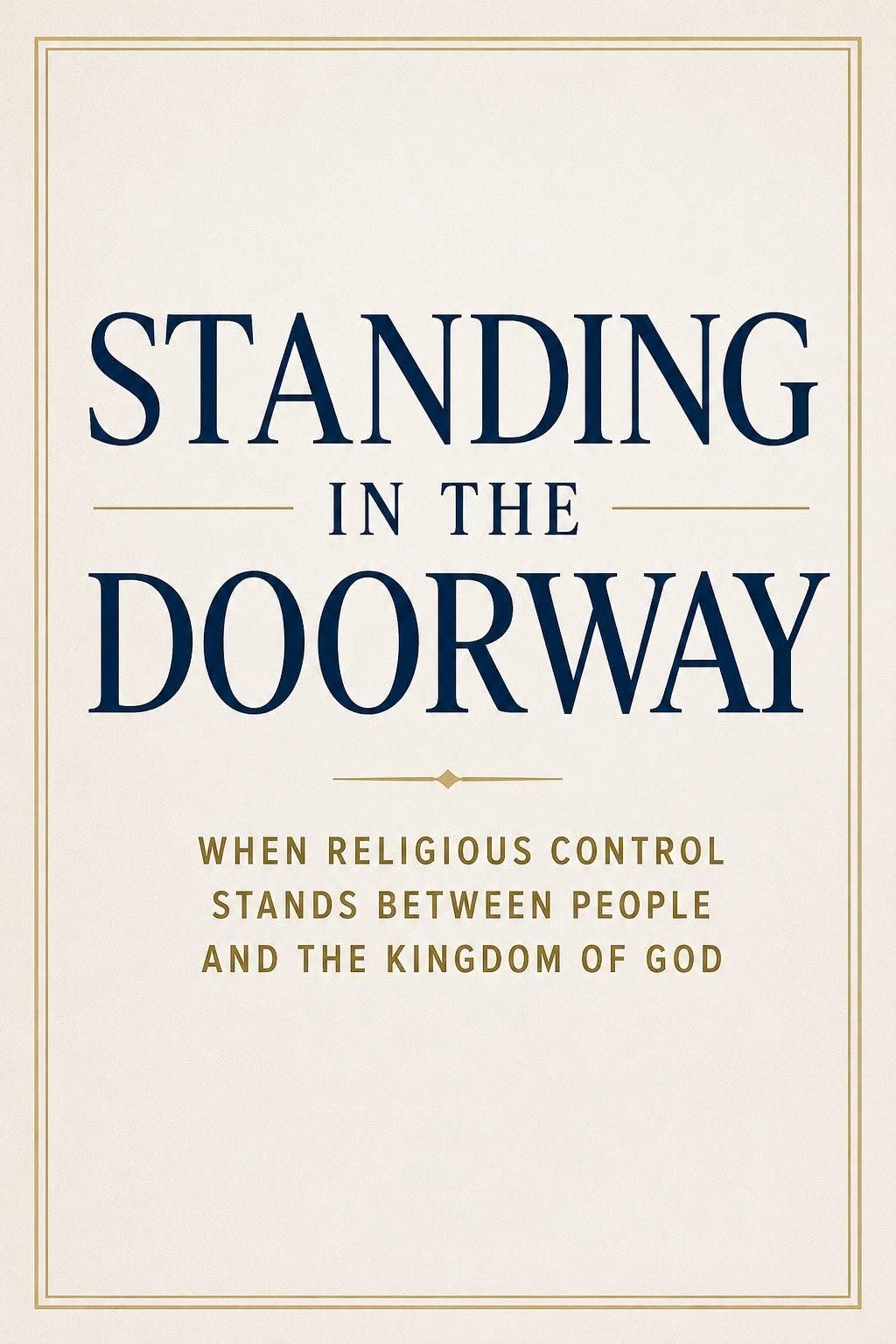
By Timothy Kitchen Jr
When Religious Control Stands Between People and the Kingdom of God
Jesus Christ reserved some of His strongest words for religious men who knew the Scriptures, occupied positions of authority, and claimed to represent God—yet became obstacles to the very people who were trying to come to God.
Christ said:
“But woe unto you, scribes and Pharisees, hypocrites! for ye shut up the kingdom of heaven against men: for ye neither go in yourselves, neither suffer ye them that are entering to go in.”
— Matthew 23:13
That is an extraordinary accusation.
Christ did not merely say that these men were failing to enter the Kingdom themselves. He said they were standing in the way of others who were entering.
They had effectively positioned themselves in the doorway.
And that warning is not merely about ancient Pharisees. It reveals a spiritual condition that God’s people must recognize and avoid today.
When Authority Becomes Control
There is a tremendous difference between God’s government and human control.
God certainly establishes authority. God’s Word teaches government, order, offices, responsibilities, correction and obedience. But legitimate spiritual authority must always remain under the authority of God.
A minister does not replace God.
A congregation does not replace God.
An organization does not replace God.
A family does not replace God.
And no human being has the authority to command another person to disobey God.
Peter and the apostles established the principle plainly:
“We ought to obey God rather than men.”
— Acts 5:29
The Pharisaical spirit turns that order upside down.
Instead of asking, “What does God command?”
it begins asking:
“What do we permit?”
Instead of helping people understand God’s law, it begins policing conformity to human expectations.
Instead of shepherding, it begins sheriffing.
A shepherd guides, feeds, protects, warns and sometimes corrects the flock according to God’s Word.
A self-appointed sheriff watches people, searches for violations of his own expectations, decides who is acceptable, and begins exercising authority God never actually gave him.
That distinction matters.
Binding Heavy Burdens
Christ said of the scribes and Pharisees:
“For they bind heavy burdens and grievous to be borne, and lay them on men’s shoulders; but they themselves will not move them with one of their fingers.”
— Matthew 23:4
The problem was not God’s law.
God’s law was never the enemy.
The problem was what men added to it.
Human requirements became confused with divine requirements. Traditions became commandments. Personal interpretations became tests of righteousness. Eventually, people could scarcely distinguish between what God actually said and what religious authorities said God meant.
Christ confronted exactly this problem:
“Full well ye reject the commandment of God, that ye may keep your own tradition.”
— Mark 7:9
That should frighten anyone entrusted with spiritual responsibility.
It is possible to become so concerned with enforcing one’s understanding, protecting one’s position, maintaining institutional control, or determining who belongs that one actually makes the commandment of God of none effect (Mark 7:13).
The person may believe he is defending God while actually standing between God and someone attempting to obey Him.
What If the Person Trying to Obey God Is Right?
This is where the test becomes uncomfortable.
Suppose someone sincerely believes God’s Word requires him to do something.
Suppose he searches the Scriptures.
Suppose he prays.
Suppose he seeks counsel.
Suppose he becomes convinced that obedience to God requires a particular course.
What should spiritual leadership do?
The proper response is to open God’s Word and prove the matter.
“Prove all things; hold fast that which is good.”
— 1 Thessalonians 5:21
Show him from Scripture if he is wrong.
Teach him.
Reason from God’s Word.
But there is an enormous difference between saying, “Here is where Scripture corrects your understanding,” and saying, “You cannot do that because we will not allow it.”
The first appeals to God’s authority.
The second may merely assert man’s authority.
And if the individual really is obeying God, anyone deliberately preventing that obedience places himself in a terrifying position.
He is no longer simply disagreeing with another person.
He may be standing in God’s way.
Gamaliel wisely warned:
“Refrain from these men, and let them alone… lest haply ye be found even to fight against God.”
— Acts 5:38-39
Partiality Corrupts Judgment
Another danger is partiality.
James writes:
“But if ye have respect to persons, ye commit sin, and are convinced of the law as transgressors.”
— James 2:9
God does not judge righteousness according to wealth, reputation, family, friendship, position, organizational importance or personal usefulness.
Yet human government easily does.
One person’s mistake is overlooked because he is influential.
Another person’s mistake becomes a major issue because he is disliked.
One family receives patience.
Another receives suspicion.
One minister is defended.
Another member is immediately condemned.
That is not righteous judgment.
Moses commanded:
“Ye shall not respect persons in judgment; but ye shall hear the small as well as the great.”
— Deuteronomy 1:17
The poor man and the important man must face the same standard.
The standard cannot be personality.
It cannot be politics.
It cannot be organizational loyalty.
It cannot be friendship.
It must be God’s Word.
Sitting in Moses’ Seat
Christ acknowledged that the scribes and Pharisees “sit in Moses’ seat” (Matthew 23:2).
They possessed real responsibility.
Their problem was not simply that authority existed.
Their problem was what they did with authority.
They loved:
“the uppermost rooms at feasts, and the chief seats in the synagogues”
— Matthew 23:6
Authority became identity.
Position became status.
And once a person begins deriving his identity from being the one who decides, governs, approves or rejects, he can become threatened by people who simply look to God.
That is where government can become control.
John described something similar concerning Diotrephes:
“Diotrephes, who loveth to have the preeminence among them, receiveth us not.”
— 3 John 9
It went even further:
“neither doth he himself receive the brethren, and forbiddeth them that would, and casteth them out of the church.”
— verse 10
Think about that.
People would receive the brethren.
Diotrephes forbade them.
He was not merely making his own choice. He was attempting to control the choices of others.
Why?
He “loveth to have the preeminence.”
That is the danger of sheriffing God’s people.
The Key of Knowledge
Christ gave another remarkable rebuke:
“Woe unto you, lawyers! for ye have taken away the key of knowledge: ye entered not in yourselves, and them that were entering in ye hindered.”
— Luke 11:52
Again notice the word entering.
These were not necessarily people running away from God.
They were trying to enter.
And religious authorities were hindering them.
Imagine answering to Jesus Christ for that.
It is serious enough for me to refuse God’s command.
How much more serious is it if I know I am not doing what God requires, yet because another person begins doing it, I discourage him?
Perhaps his obedience exposes my disobedience.
Perhaps his sacrifice exposes my unwillingness to sacrifice.
Perhaps his faith exposes my lack of faith.
Perhaps his zeal exposes my complacency.
The temptation then becomes to find something wrong with him, rather than confronting what his example reveals about me.
That is a very dangerous spiritual condition.
“If I Cannot Enter, Neither Will You”
This is perhaps one of the darkest consequences of the Pharisaical spirit.
A person may recognize, somewhere within himself, that he is not willing to pay the price obedience requires.
But instead of repenting, he begins redefining obedience.
Then someone else comes along who is willing.
Rather than encouraging that person, he says:
“You don’t have to do that.”
“You shouldn’t do that.”
“You cannot do that.”
“We don’t do that.”
“You need our permission.”
And eventually:
“If you do that, there will be consequences.”
Now the issue has changed.
A person’s own unwillingness to obey has become an attempt to prevent another person’s obedience.
Christ said:
“ye neither go in yourselves, neither suffer ye them that are entering to go in.”
That is Matthew 23:13 happening again in principle.
Not Lords Over God’s Heritage
Peter gave ministers an explicit warning concerning how God’s people are to be governed:
“Neither as being lords over God’s heritage, but being ensamples to the flock.”
— 1 Peter 5:3
Notice whose heritage it is.
God’s.
The sheep do not belong to the minister.
They do not belong to a board.
They do not belong to an institution.
They belong to God.
Christ told Peter:
“Feed my sheep.”
— John 21:16
He did not say, Own My sheep.
He did not say, Control My sheep.
He said feed them.
Paul likewise explained:
“Not for that we have dominion over your faith, but are helpers of your joy: for by faith ye stand.”
— 2 Corinthians 1:24
What a beautiful definition of proper spiritual leadership:
helpers.
Not dominators of another person’s faith.
Helpers.
There Is Also Another Danger
None of this means every individual can simply declare, “God told me,” and become immune from correction.
That would be another form of rebellion.
God commands humility, counsel, correction and submission to rightful authority. A person can deceive himself just as surely as a leader can abuse authority.
Therefore both sides must come under the same test:
What does God actually say?
Not:
“What do I want?”
Not:
“What does the minister want?”
Not:
“What does the organization prefer?”
Not:
“What has always been done?”
But:
“What saith the scripture?”
— Romans 4:3
God’s Word judges both the governed and the governor.
Do Not Block the Door
Every Christian should therefore examine himself.
Am I helping people toward God—or making their path harder?
Am I teaching God’s commandments—or my preferences?
Am I correcting sin—or policing personalities?
Do I judge the same behavior differently depending upon who does it?
Do I feel threatened when someone takes obedience further than I have been willing to take it?
Do I use authority to serve—or to control?
And perhaps most seriously:
Have I ever discouraged someone from obeying something I privately knew God required because I was unwilling to do it myself?
Christ said:
“Whosoever therefore shall break one of these least commandments, and shall teach men so, he shall be called the least in the kingdom of heaven.”
— Matthew 5:19
The opposite follows immediately:
“but whosoever shall do and teach them, the same shall be called great in the kingdom of heaven.”
Do and teach.
That is God’s pattern.
Not prevent.
Not control.
Not show partiality.
Not create additional commandments.
Not sheriff God’s people.
Feed them.
Teach them.
Warn them.
Correct them from Scripture.
Set the example.
And then point them toward God.
Because ultimately there is only one Door into God’s Kingdom.
Jesus Christ said:
“I am the door: by me if any man enter in, he shall be saved.”
— John 10:9
No minister stands in that doorway as its owner.
No organization owns the entrance.
No human authority possesses the keys to redefine God’s conditions.
Christ is the Door.
Our responsibility is to help people find Him, follow Him and obey the Father—not to stand in front of the entrance.
The Pharisees were condemned because they stood where they never belonged.
May we never become the people of whom Christ must say:
You would not enter—and you hindered those who were trying.
Leave a Reply