By Timothy Kitchen
Occupation Is Not Divine Appointment, and Remaining Somewhere Does Not Make a Man King.
There is a difference between occupying a place and being appointed to it.
There is a difference between possessing something and being its rightful owner.
There is a difference between remaining somewhere and remaining where God commanded us to be.
And there is a difference between holding a position and being chosen by God to hold it.
These distinctions are important because men often judge authority by what they can see.
They look at who occupies a building, who possesses the records, who has the longest history, who has the most followers, or who continues exercising control.
But is that how God determines authority?
Does remaining somewhere establish that God placed us there?
Does occupying a position make us the rightful ruler over those whom God has called elsewhere?
And if God calls His people to return to what He established, must they submit to those who remained in places God never appointed to become His throne?
Consider an illustration.
A kingdom has been overthrown.
Its people have been scattered. Its palace has fallen into ruin. The throne has been removed, and the place where the king once governed lies desolate.
Yet one building remains standing.
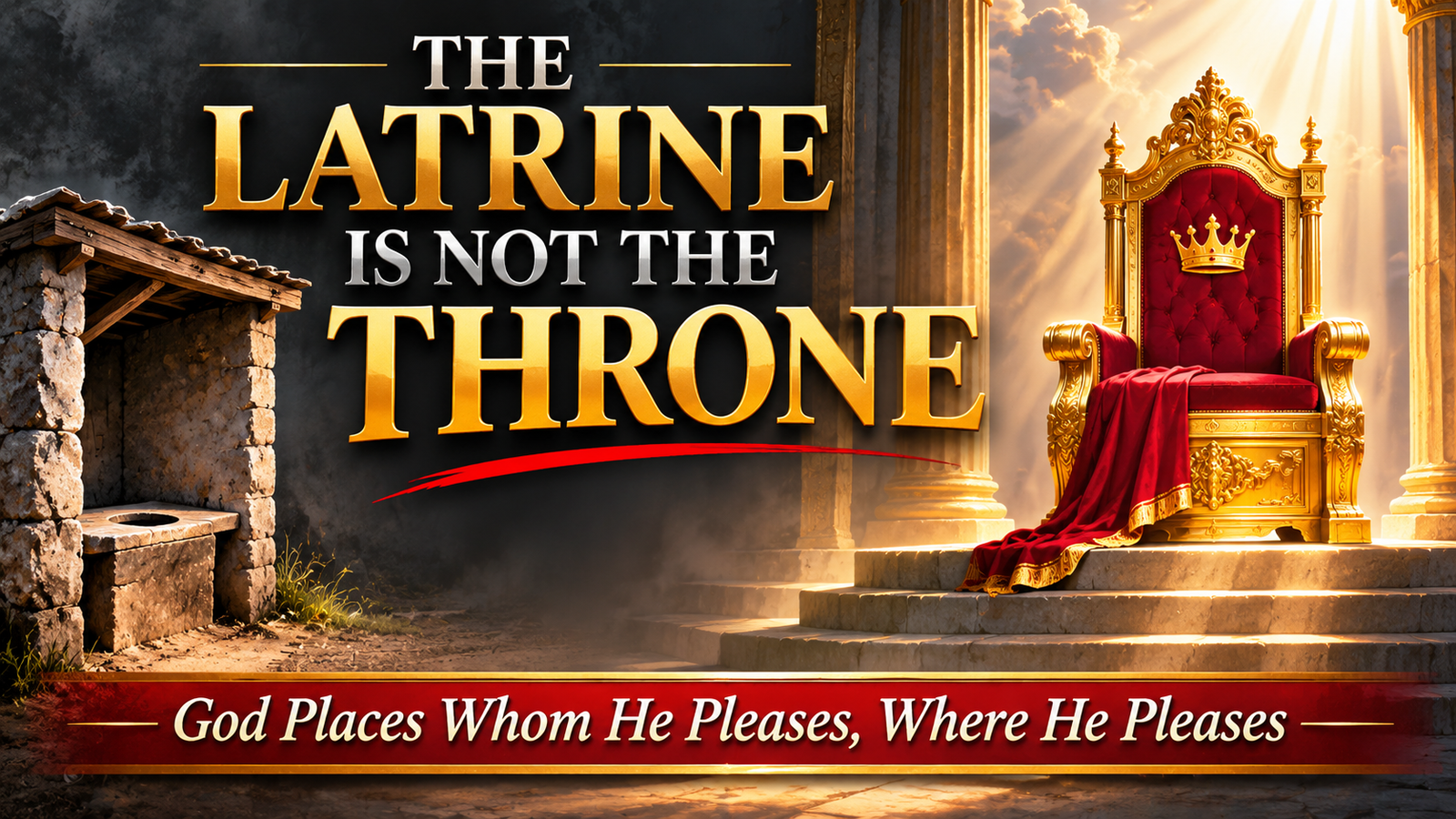
The latrine.
A man continues occupying it.
He maintains the building. He preserves its records. He remembers that it once belonged to the kingdom.
Years pass.
Then the king commands his scattered people to return.
They return to the place he established. They begin rebuilding the palace and restoring the throne.
But the man who remained in the latrine objects.
He declares that because he never left, his building must now be the seat of government.
Because he remained, he believes he possesses authority over those who returned.
He insists that the returning servants must recognize him as their ruler.
But who appointed him?
Did the king transfer the throne to the latrine?
Did the king appoint its occupant to rule over the kingdom?
Or did the man mistake his continued occupation for divine appointment?
A latrine does not become a throne merely because it is the last building standing.
And a throne does not cease to be the throne merely because it must be restored.
The question is not who remained the longest.
The question is not who possesses the oldest building.
The question is: What did the King establish, whom did He appoint, and where did He command His servants to be?
This illustration is a parable, not a historical event. But the principle behind it can be examined throughout the history recorded in God’s Word.
And it begins with one fundamental truth.
God is the Owner.
I. GOD IS THE OWNER — MAN IS NOT
Before we can understand God’s placement of His people, we must understand God’s ownership.
Who owns the earth?
Who owns the land?
Who owns the Church?
Who owns the people He has called?
Psalm 24:1 declares:
“The earth is the LORD’S, and the fulness thereof; the world, and they that dwell therein.”
Everything belongs to God.
Not merely the land.
Not merely the buildings.
Not merely the possessions.
Even those who dwell upon the earth belong to Him.
Man may possess property.
Man may administer governments.
Man may occupy positions of responsibility.
But none of these things makes man the ultimate owner.
Consider what God told ancient Israel.
Leviticus 25:23:
“The land shall not be sold for ever: for the land is mine; for ye are strangers and sojourners with me.”
Notice those words.
“The land is mine.”
God had given Israel an inheritance.
Yet even Israel was not the ultimate owner.
God was.
Israel received its inheritance from Him and remained accountable to Him.
Receiving authority from God does not make a person independent of God.
Receiving an inheritance does not make a person greater than the One who gave it.
And receiving an office does not make a person the owner of those entrusted to his care.
This principle applies to the land of Israel.
It applies to the Temple.
And it applies to the Church of God.
God remains the Owner.
And Jesus Christ remains the Head of His Church.
II. ABRAHAM WAS A STRANGER IN THE LAND GOD PROMISED HIM
When God called Abraham, He commanded him to leave his country and go to a land that He would show him.
Genesis 12:1 records that calling.
Abraham obeyed.
Yet when he arrived, he did not find an empty land awaiting him.
Genesis 12:6 tells us:
“…and the Canaanite was then in the land.”
The Canaanites were already there.
They had settlements.
They had established communities.
They occupied the territory.
From the world’s perspective, Abraham was the stranger.
Yet God had made a promise.
Genesis 17:8:
“And I will give unto thee, and to thy seed after thee, the land wherein thou art a stranger, all the land of Canaan, for an everlasting possession; and I will be their God.”
Consider the distinction.
Abraham was a stranger in the very land God promised him.
Others occupied it.
But God’s promise did not originate with those occupants.
It originated with God.
The occupation of the land did not determine the covenant God made concerning it.
Neither did Abraham’s lack of possession cancel God’s promise.
God had spoken.
And the fulfillment of that promise rested upon His faithfulness.
But Abraham did not immediately seize the entire land simply because God had promised it.
He lived as a stranger and pilgrim.
He waited upon God.
This teaches another important lesson.
A promise from God does not authorize a man to act independently of God’s instructions concerning its fulfillment.
God determines what He gives.
God determines to whom He gives it.
And God determines when and how His purpose is accomplished.
III. ISRAEL’S INHERITANCE — GOD GAVE BEFORE ISRAEL POSSESSED
Centuries later, God brought the children of Israel out of Egypt.
They had been enslaved.
They had no established kingdom in Canaan.
They wandered through the wilderness.
Meanwhile, the land was inhabited by other nations.
The Canaanites and other peoples occupied its cities and territories.
From the world’s perspective, one might have asked:
Who occupies the land?
Who possesses the fortified cities?
Who has established government there?
Who controls its territory?
But Scripture introduces the fact that changes the biblical question.
God had made a covenant.
Joshua 21:43 declares:
“And the LORD gave unto Israel all the land which he sware to give unto their fathers; and they possessed it, and dwelt therein.”
Notice the order.
God gave.
Israel possessed.
Israel dwelt.
The gift came from God.
The possession followed.
Israel did not create God’s promise by occupying the land.
God’s promise preceded Israel’s possession.
This does not mean that every historical or modern territorial dispute can be resolved simply by identifying ancient inhabitants. The biblical covenant account and present-day political questions are distinct matters.
But the spiritual principle remains.
Occupation alone does not establish divine ownership or appointment.
The question is what God has determined.
And this becomes even clearer when we examine Israel’s captivity.
IV. CAPTIVITY DID NOT TRANSFER GOD’S OWNERSHIP
God gave Israel the land.
But Israel disobeyed Him.
God warned that disobedience would bring consequences.
Leviticus 26 and Deuteronomy 28 describe blessings for obedience and curses for disobedience.
Among those consequences was removal from the land.
And that is precisely what occurred.
The northern kingdom of Israel was carried into Assyrian captivity.
Later, Judah was carried into Babylonian captivity.
Jerusalem was conquered.
The Temple was destroyed.
The people were scattered.
Other rulers exercised authority over the land.
But did God cease being its Owner?
Did Babylon become the author of God’s covenant because Babylon conquered Jerusalem?
Did Nebuchadnezzar become the God of Israel because his armies occupied the city?
Of course not.
Babylon possessed political and military power.
But Babylon did not become the source of God’s promises.
God had permitted Judah’s captivity as judgment for disobedience.
And God had also determined that a remnant would return.
Jeremiah 29:10 records God’s promise concerning the completion of seventy years and His bringing the people back.
The captivity did not destroy God’s authority.
The occupation did not replace God’s ownership.
And the return did not require Babylon to become the author of Israel’s restoration.
God remained God throughout the captivity.
When we remove God from the picture, we are left examining human possession, military strength, political control, and institutional continuity.
But when we keep God in the picture, we must ask what He commanded, what He promised, and whom He appointed.
And this brings us to Zerubbabel.
V. ZERUBBABEL — RETURNING TO THE PLACE GOD ESTABLISHED
When God determined that the Jewish exiles should return, He brought about the circumstances for their restoration.
Cyrus conquered Babylon in 539 BC.
The biblical account records that Cyrus subsequently authorized the rebuilding of the Temple in Jerusalem.
The people returned.
And what did they return to do?
Did they establish a different God?
Did they create an unrelated covenant?
Did they select another city and declare it the new Jerusalem?
No.
They returned to the place God had established.
They rebuilt the altar.
They laid the foundation of the Temple.
They restored worship according to the law God had given through Moses.
Ezra 3:2 specifically records that the altar was built according to what was written in the law of Moses.
The work was restoration.
Not replacement.
And God identified Zerubbabel’s responsibility in that work.
Zechariah 4:9 declares:
“The hands of Zerubbabel have laid the foundation of this house; his hands shall also finish it…”
Notice something important.
The work was not authorized merely because Zerubbabel happened to occupy Jerusalem.
Nor was Zerubbabel appointed simply because he possessed an old building.
God identified the work and the servant through whom it would be accomplished.
The appointment did not originate in the building.
It originated with God.
Ezra 4 records that adversaries approached Zerubbabel and the leaders of the returning exiles, offering to participate in the rebuilding.
Zerubbabel and the leaders refused.
The adversaries subsequently sought to hinder the work.
The rebuilding of God’s Temple was not to be redirected by those who lacked the commission given for that work.
The returning people had a responsibility to fulfill.
And their responsibility was not determined merely by the continued presence of others in the land.
The Temple belonged to God.
The work belonged to God.
And the commission came from God.
VI. GOD DOES NOT ESTABLISH COMPETING TEMPLES
Consider the significance of the return.
God did not command Zerubbabel to establish a collection of competing temples.
He did not command the returning exiles to divide themselves into separate religious bodies, each with its own independent foundation.
He directed the rebuilding of His house.
The people were called to return to the place God had established.
And the work was to be accomplished according to His instructions.
This historical account gives us a question to consider concerning the Church of God.
If Christ established one Church, why should men assume that dividing into competing religious organizations creates additional legitimate bodies of Christ?
If Christ is the Head of His Church, why should men establish separate governments and then claim that their divisions are expressions of the same unity?
If God places the members in the Body as it pleases Him, why should men believe they can determine their own placement according to personal preference?
God does not establish competing spiritual bodies.
Ephesians 4:4–5 declares:
“There is one body, and one Spirit, even as ye are called in one hope of your calling; One Lord, one faith, one baptism.”
Notice what Scripture says.
One Body.
One Spirit.
One Lord.
One faith.
Not several competing bodies.
Not several independent heads.
Not several different faiths.
The Church is one spiritual organism.
Jesus Christ is its Head.
And the members are placed by God.
The historical restoration under Zerubbabel illustrates the importance of returning to what God established rather than inventing a replacement.
But it does not authorize any man to appoint himself as a modern Zerubbabel.
That appointment, like every genuine spiritual responsibility, must come from God.
VII. SAUL AND DAVID — OCCUPATION IS NOT APPOINTMENT
Consider another historical account.
Saul was king over Israel.
He possessed the outward instruments of kingship.
He had the royal position.
He had an army.
He exercised political authority.
Yet Saul disobeyed God.
And God rejected him from continuing as king.
In 1 Samuel 16, God directed Samuel to anoint David.
David was chosen to succeed Saul.
But David did not immediately occupy the throne.
Instead, he spent years fleeing Saul.
Saul continued exercising royal authority.
David lived as a fugitive.
Now consider the distinction.
Who occupied the royal office?
Saul.
Who had been chosen by God to succeed him?
David.
Saul’s continued occupation did not cancel God’s appointment of David.
But David also understood that God’s appointment did not give him permission to murder Saul or seize the throne by his own will.
David repeatedly refused to harm Saul.
He waited upon God.
Here we find two principles that must never be separated.
First, continued occupation does not establish that God approves everything an occupant does.
Second, divine appointment does not authorize a person to disregard God’s law or act presumptuously.
David did not become king because he merely declared himself king.
He did not become king because he gathered enough supporters.
God had chosen him.
And in God’s time, he received the kingdom.
God’s appointment must be distinguished from outward possession and personal ambition.
VIII. ADONIJAH — A MAN WHO APPOINTED HIMSELF
As David grew old, Adonijah attempted to establish himself as king.
He gathered supporters.
He obtained the support of influential men.
He arranged a public celebration.
He behaved as though the throne already belonged to him.
But Scripture reveals the origin of his claim.
1 Kings 1:5:
“Then Adonijah the son of Haggith exalted himself, saying, I will be king…”
Notice those words.
“Exalted himself.”
Adonijah declared his own authority.
He gathered others who recognized his claim.
But the gathering of supporters did not make him God’s chosen successor.
David had designated Solomon to succeed him.
The public ceremony did not settle the matter.
The influential supporters did not settle the matter.
Adonijah’s confidence did not settle the matter.
The question was who had been appointed.
Hebrews 5:4 declares:
“And no man taketh this honour unto himself, but he that is called of God, as was Aaron.”
The immediate context concerns the priesthood, but it demonstrates that sacred office is not something a man may simply seize for himself.
There is a difference between being called and calling oneself.
There is a difference between being appointed and announcing one’s appointment.
No amount of self-exaltation can substitute for a calling from God.
IX. KORAH — BEING GIVEN ONE PLACE DOES NOT GIVE AUTHORITY OVER EVERY PLACE
Numbers 16 provides another important lesson.
Korah and his associates challenged the authority God had given Moses and Aaron.
They argued that the congregation was holy.
But Moses reminded them that God had already separated the Levites for a particular service.
Numbers 16:9–10 reveals that they had been given an honorable responsibility, yet they sought the priesthood also.
They were not satisfied with the place God had given them.
They desired another.
Moses answered in Numbers 16:5:
“…the LORD will shew who are his, and who is holy; and will cause him to come near unto him…”
Who determines the appointment?
God.
Who determines whom He brings near?
God.
Who determines the responsibilities of His servants?
God.
A person appointed to one responsibility cannot assume that every other responsibility belongs to him.
And another person cannot simply seize that responsibility because he believes he is equally qualified.
God places whom He pleases, where He pleases.
The responsibility of the servant is to faithfully perform the work God has assigned.
Not to exalt himself above his brethren.
Not to seize another man’s responsibility.
Not to make himself the head of God’s people.
But to serve in the place God has given him.
X. THE CHURCH IS ONE SPIRITUAL ORGANISM
Now we come to the central New Testament teaching.
1 Corinthians 12:18:
“But now hath God set the members every one of them in the body, as it hath pleased him.”
Read those words carefully.
God hath set the members.
Every one of them.
In the Body.
As it hath pleased Him.
Who places the members?
God.
The members do not establish their own spiritual placement according to personal preference.
They do not create additional bodies because they disagree with the responsibilities God has assigned.
They do not establish competing governments and then declare that each possesses the same divine authority.
God places the members in one Body.
And that Body is the Church of God.
The Church is a spiritual organism composed of those whom God has called and chosen, who have received His Holy Spirit and are led by that Spirit.
Romans 8:9 declares:
“…Now if any man have not the Spirit of Christ, he is none of his.”
And Romans 8:14 states:
“For as many as are led by the Spirit of God, they are the sons of God.”
The presence and leadership of God’s Holy Spirit are essential.
A name does not make someone a member of Christ’s Body.
A building does not make someone a member.
Merely attending religious services does not, by itself, establish spiritual conversion.
God calls.
God grants repentance.
God gives His Holy Spirit.
And God places the members in the Body as it pleases Him.
This is the spiritual organism.
Not a collection of competing religious organizations.
Not a gathering of independent bodies claiming separate authority.
One Body, under one Head, led by one Spirit.
XI. CHRIST IS NOT DIVIDED
Consider what Paul wrote to the Corinthians.
1 Corinthians 1:10:
“Now I beseech you, brethren, by the name of our Lord Jesus Christ, that ye all speak the same thing, and that there be no divisions among you; but that ye be perfectly joined together in the same mind and in the same judgment.”
Paul did not encourage division.
He did not tell the Corinthians to establish separate organizations under different leaders.
He did not teach that competing religious bodies were an acceptable expression of spiritual unity.
He corrected them.
Some were saying they belonged to Paul.
Others to Apollos.
Others to Cephas.
Paul asked:
“Is Christ divided?” — 1 Corinthians 1:13.
That question must be answered.
Christ is not divided.
His Body is not divided into competing spiritual bodies.
His government is not established by men appointing themselves.
The existence of different religious organizations does not establish that God has authorized their divisions.
Neither does the claim that all acknowledge Jesus Christ make their disagreements and separate governments acceptable.
Christ prayed for unity.
John 17:21:
“That they all may be one; as thou, Father, art in me, and I in thee, that they also may be one in us…”
This is not a call for competing bodies to remain divided while merely claiming spiritual fellowship.
It is a call to unity in God and Jesus Christ.
Unity in truth.
Unity in faith.
Unity under the Headship of Christ.
God does not command His people to preserve division.
He commands them to be one.
XII. GOD CALLS HIS PEOPLE TO THE PLACE HE HAS APPOINTED
Consider a king who summons his servants.
He tells them where to assemble.
He gives each servant a responsibility.
Some are appointed to one task.
Others are appointed to another.
But all serve the same king, under the same government, according to the same command.
Those who faithfully answer the summons take their appointed places.
They remain obedient.
They continue the work.
Now suppose some become dissatisfied.
They depart.
They establish another gathering elsewhere.
They appoint their own leaders.
They give their gathering another name.
Then they announce that because they still acknowledge the same king, their separate gathering must possess the same authority as the one he established.
But did the king command them to establish it?
Did he appoint its leaders?
Did he authorize them to depart from the place where he had put them?
Simply claiming allegiance to the king does not establish that the king authorized their departure.
The question is not whether they continue using the king’s name.
The question is whether they are obeying the king’s instructions.
This is why the distinction between occupation and divine appointment is so important.
A man may remain in a place God never appointed him to occupy.
Another may depart from the very place God commanded him to remain.
Still another may repent and return to the place from which he departed.
But none of them determines his own spiritual placement.
God does.
And the responsibility of those called is to remain faithful to that calling.
XIII. HOLD FAST — THAT NO MAN TAKE THY CROWN
Jesus Christ gave the Philadelphia Church a remarkable instruction.
Revelation 3:11:
“Behold, I come quickly: hold that fast which thou hast, that no man take thy crown.”
Notice the command.
Hold fast.
Why would Christ command His people to hold fast if it made no difference whether they remained faithful to what He had given them?
Why warn them concerning their crown if departure from the truth carried no spiritual danger?
Christ did not tell Philadelphia to establish something different.
He told them to hold fast.
And holding fast means remaining faithful to what was received.
It means not surrendering the truth.
Not abandoning the calling.
Not exchanging the government of God for the preferences of men.
Not following those who establish competing foundations.
Not allowing another man to take what Christ has promised to those who overcome.
Consider Revelation 3:8:
“…for thou hast a little strength, and hast kept my word, and hast not denied my name.”
Notice what Christ commended.
They kept His Word.
They did not deny His name.
And He commanded them to continue holding fast.
The crown is not promised because someone possesses a particular building.
It is not promised because someone maintains a religious name.
It is promised in connection with overcoming and remaining faithful to Jesus Christ.
Those who knowingly abandon God’s truth and refuse to repent place themselves in spiritual danger.
But those who have been scattered, displaced, or separated through circumstances beyond their control should not automatically be condemned as having abandoned Christ.
God knows those who are His.
And He knows whether they are holding fast to His Word.
The warning remains.
Do not abandon what Christ has given.
Do not exchange His calling for another foundation.
Do not assume that departure carries no consequences.
Hold fast.
XIV. THE SHEPHERDS DO NOT OWN THE SHEEP
Consider Ezekiel 34.
God speaks against the shepherds of Israel.
They occupied positions of responsibility.
They had been entrusted with the care of the flock.
Yet they failed to fulfill their responsibilities.
Ezekiel 34:2 declares:
“…Woe be to the shepherds of Israel that do feed themselves! should not the shepherds feed the flocks?”
Their responsibility was to care for the sheep.
Not to use the sheep for their own advantage.
Not to make themselves the owners of the flock.
Not to treat their position as an inheritance independent of God.
Then God declares in Ezekiel 34:11:
“For thus saith the Lord GOD; Behold, I, even I, will both search my sheep, and seek them out.”
Whose sheep?
God’s sheep.
The shepherds were entrusted with their care.
But the sheep belonged to God.
When the shepherds failed, God did not cease to be the Owner.
He declared that He would seek His sheep.
He would gather them.
He would care for them.
Now consider John 10.
Jesus Christ identifies Himself as the Good Shepherd.
John 10:11:
“I am the good shepherd: the good shepherd giveth his life for the sheep.”
The true Shepherd gives Himself for the sheep.
The unfaithful shepherd uses the sheep for himself.
This is a necessary warning concerning every claim of religious authority.
A minister does not own God’s people.
A leader does not become the Head of the Church because he has remained in a particular position.
The sheep belong to Christ.
And the shepherds must answer to Him.
XV. RETURNING TO THE FOUNDATION — NOT CREATING ANOTHER
Now return to Zerubbabel.
God had established Jerusalem as the place of His Temple.
The Temple was destroyed.
The people were scattered.
But when God commanded the restoration, the returning exiles did not invent another foundation.
They returned to the place God had established.
They rebuilt.
They restored.
They continued the work associated with God’s covenant and His commands.
This provides a historical pattern worth examining in relation to the Church.
When God’s people have been scattered, is the answer simply to establish another organization?
And another?
And another?
Does the creation of competing organizations restore the unity of the Body?
Does a new name establish a new divine commission?
Does a declaration of authority establish an apostle?
Or must God’s people return to the foundation Christ established?
Ephesians 2:20 speaks of the Church as:
“And are built upon the foundation of the apostles and prophets, Jesus Christ himself being the chief corner stone.”
There is the foundation.
Jesus Christ.
His apostles and prophets.
The truth He established.
The spiritual structure of His Church.
This foundation cannot be replaced by human ambition.
Neither can it be recreated by men who appoint themselves to positions God has not given them.
The Church must remain founded upon Jesus Christ.
The historical return under Zerubbabel provides an illustration of restoration, but it should not be treated as automatic proof that any particular modern leader fulfills Zerubbabel’s role.
Such claims require scriptural examination.
Nevertheless, the question remains important.
Are we returning to what Christ established, or are we merely creating something new and calling it restoration?
XVI. THE LATRINE IS NOT THE THRONE
Now return to our opening illustration.
The kingdom has been scattered.
The palace has fallen.
The throne must be restored.
And one man remains in the latrine.
He may have faithfully maintained that building.
He may have preserved valuable records.
He may have performed a necessary service.
There is no reason to despise honest service.
Indeed, the person who faithfully performs a humble responsibility may be serving the king exactly as commanded.
But that faithful service does not automatically appoint him to another office.
The man who maintains the latrine is not made king by the disappearance of the palace.
Nor is the man who returns to rebuild the palace automatically made king simply because he has returned.
Both must recognize the authority of the King.
If the king appointed one servant to maintain the latrine, that servant should faithfully perform his responsibility.
If the king appointed another to restore the palace, that servant should faithfully perform his responsibility.
Neither may seize the other’s commission.
Neither may exalt himself above the king.
And neither may claim that his own occupation establishes authority over everyone else.
The issue is not whether the latrine is useful.
The issue is not whether the man who remained performed a valuable service.
The issue is whether he has mistaken his assigned responsibility for authority he was never given.
The latrine remains the latrine.
The throne remains the throne.
And the King remains the King.
XVII. WITHOUT GOD IN THE PICTURE, OCCUPATION BECOMES THE STANDARD
When men examine history without considering God’s authority, they often measure legitimacy by possession.
Who controls the territory?
Who occupies the office?
Who possesses the records?
Who retains the name?
Who controls the property?
Who has the greatest number of followers?
Who has the longest uninterrupted institutional history?
These may be important historical facts.
But none of them, by itself, establishes divine appointment.
From a purely human perspective, possession may determine who exercises practical control.
Yet practical control is not the same thing as ultimate ownership.
And legal authority is not necessarily the same thing as spiritual authority.
God must remain in the picture.
Otherwise, men begin treating the occupant as the owner.
They begin treating the administrator as the head.
They begin treating continued possession as proof that God has appointed them to rule.
But Scripture directs us elsewhere.
Psalm 24:1 tells us that the earth belongs to God.
Leviticus 25:23 tells us that the land belongs to God.
1 Corinthians 12:18 tells us that God places the members in the Body.
Ephesians 1:22–23 tells us that Christ is the Head of the Church.
And Ezekiel 34 reminds us that the sheep belong to God, not to the shepherds entrusted with their care.
These scriptures establish the proper order.
God is the Owner.
Christ is the Head.
The members are placed by God.
And every servant is accountable for the responsibility given to him.
XVIII. THE DANGER OF SELF-APPOINTMENT
There is another danger that must not be overlooked.
A person may recognize that another man has wrongly claimed authority.
He may recognize that God’s people must return to the truth and foundation Christ established.
But then he may make the very same mistake.
He may appoint himself.
He may declare that because he understands the need for restoration, he must therefore be the one appointed to govern everyone else.
He may gather followers.
He may establish an organization.
He may claim the authority of a former servant of God.
But understanding that restoration is necessary does not, by itself, establish who has been commissioned to accomplish it.
Adonijah teaches us the danger of self-exaltation.
Korah teaches us the danger of seeking a responsibility God has not given.
David teaches us the importance of waiting upon God.
Zerubbabel teaches us that the work must be accomplished according to God’s commission.
And Paul teaches us that God places every member in the Body as it pleases Him.
Therefore, the standard must be applied equally.
To the person who remained.
To the person who departed.
To the person who returned.
And to the person who claims to lead the restoration.
No one becomes the Head of the Church.
Jesus Christ already occupies that position.
And He has not surrendered it.
XIX. THE QUESTION IS NOT WHO STAYED — BUT WHO OBEYED
Throughout Scripture, God’s servants have been called to leave places they once occupied.
Abraham was called to leave his country.
Israel was called out of Egypt.
Judah was later permitted to return from Babylon.
David was required to flee from Saul.
The apostles were called to follow Jesus Christ.
Yet Scripture also records servants who were commanded to remain where God had placed them.
The question was never simply whether leaving or remaining was inherently righteous.
The question was obedience.
Did God command them to go?
Did God command them to remain?
Did God appoint them to that responsibility?
Were they faithful to His instructions?
This is what matters.
A man may remain somewhere because God placed him there.
Another may depart because God called him elsewhere.
Neither action, by itself, establishes superiority.
And neither gives a servant authority to despise another member of the Body.
The proper question is not merely where a person is standing.
It is whether he is standing where God has placed him.
And whether he is faithfully performing the work God has given him.
XX. RETURNING TO THE PLACE GOD PUT US
When we speak of returning to the foundation of the Worldwide Church of God, what are we actually saying?
Are we speaking of returning to a physical headquarters?
Are we speaking of recovering a familiar name?
Or are we speaking of returning to the truth, the calling, the commission, the government, and the spiritual foundation established by Jesus Christ?
These are not necessarily the same thing.
A physical headquarters may be sold.
An institution may change its teachings.
A name may continue to exist while the beliefs associated with it change.
But Jesus Christ remains the Head of His Church.
And the foundation of His Church remains what He established.
The question for God’s people is therefore not simply which organization has the oldest claim.
Nor is it which leader has the greatest number of followers.
The question is whether we are holding fast to what Christ gave.
Revelation 3:11 declares:
“Behold, I come quickly: hold that fast which thou hast, that no man take thy crown.”
Notice the command.
Hold fast.
Not invent a different foundation.
Not surrender the truth.
Not exalt ourselves.
Not make another man the Head.
But hold fast to what Christ has given.
And if we have departed from what He established, then we must repent and return to Him.
Not merely to a human institution.
Not merely to a familiar name.
But to Jesus Christ and His truth.
XXI. GOD DETERMINES THE PLACE — AND GOD DETERMINES THE WORK
We began with a simple illustration.
A latrine remained standing.
A throne needed restoration.
And a man confused his continued occupation with authority over the kingdom.
But Scripture reveals that the real question is much greater than buildings.
It concerns the government of God.
It concerns divine appointment.
It concerns the calling of His servants.
It concerns the ownership of His people.
And it concerns the Headship of Jesus Christ over His Church.
God promised Abraham an inheritance while Abraham was still a stranger.
God brought Israel into the land He had promised.
God permitted captivity when His people disobeyed.
God brought a remnant back to Jerusalem.
God identified Zerubbabel’s responsibility in rebuilding the Temple.
God chose David to succeed Saul.
God established the priesthood and its responsibilities.
And God places the members in the Body of Christ as it pleases Him.
In every case, the central issue is God’s authority.
Not merely human possession.
Not merely continued occupation.
Not merely outward appearance.
And not merely personal claims.
The servant must recognize the Master.
The shepherd must recognize the Owner of the sheep.
The member must recognize the Head of the Body.
And the one who has been given a responsibility must not mistake that responsibility for ownership of everything else.
God places whom He pleases, where He pleases.
That is His prerogative.
And the responsibility of every servant is to obey.
CONCLUSION: THE KING HAS NEVER ABDICATED
The palace may fall.
The people may be scattered.
The institutions of men may change.
Buildings may be destroyed.
Leaders may rise and fall.
Some may remain.
Others may depart.
Still others may be called to return.
But none of these things changes the identity of the King.
Jesus Christ has never abdicated His throne.
He has never surrendered His Headship over the Church.
And He has never authorized men to appoint themselves as the supreme authority over His Body.
God remains the Owner.
Christ remains the Head.
And God continues to place the members in the Body as it pleases Him.
Therefore, let every servant examine his own calling.
Let every shepherd remember whose sheep he serves.
Let every member recognize the place God has given him.
And let no man mistake continued occupation for divine appointment.
For the man who remained in the latrine may have performed a useful service.
But he did not become king merely because he remained.
And the man who returned to the palace did not become king merely because he returned.
The King determines who serves, where they serve, and what responsibility they receive.
The throne belongs to the King.
The kingdom belongs to the King.
And the servants belong to the King.
A latrine does not become a throne because it remains standing.
A throne does not cease to be a throne because it must be restored.
And the King does not cease to be King because men have forgotten where He placed them.
“But now hath God set the members every one of them in the body, as it hath pleased him.”
— 1 Corinthians 12:18
SCRIPTURAL AND HISTORICAL REFERENCES
The Ownership of God
- Psalm 24:1 — The earth belongs to the LORD.
- Leviticus 25:23 — The land belongs to God.
- Genesis 12:1–7 — Abraham’s calling and the Canaanites in the land.
- Genesis 17:7–8 — God’s covenant with Abraham.
- Joshua 21:43 — God gave Israel the land.
Captivity and Restoration
- Leviticus 26 — The consequences of disobedience.
- Deuteronomy 28 — Blessings and curses.
- Jeremiah 29:10 — God’s promise concerning the return.
- Ezra 1–6 — The return and rebuilding of the Temple.
- Haggai 1–2 — God’s command to rebuild.
- Zechariah 4:6–10 — Zerubbabel and the Temple.
Divine Appointment and Authority
- 1 Samuel 15–16 — Saul’s rejection and David’s anointing.
- 1 Samuel 24 and 26 — David refuses to harm Saul.
- 1 Kings 1–2 — Adonijah and Solomon.
- Numbers 16–17 — Korah and the priesthood.
- Hebrews 5:4 — No man takes sacred honor to himself.
Christ and His Church
- 1 Corinthians 1:10–13 — Christ is not divided.
- 1 Corinthians 12:12–28 — God places the members in the Body.
- Romans 8:9, 14 — God’s Holy Spirit and His children.
- Romans 12:4–8 — Different members and responsibilities.
- Ephesians 1:22–23 — Christ is Head over the Church.
- Ephesians 2:19–22 — The foundation of the Church.
- Ephesians 4:4–16 — One Body, one faith, and the gifts Christ gives.
- Colossians 1:18 — Christ is the Head of the Body.
- Ezekiel 34 — God’s judgment upon unfaithful shepherds.
- John 10:1–18 — Jesus Christ, the Good Shepherd.
- John 17:20–23 — Christ’s prayer for unity.
- Revelation 3:7–13 — Philadelphia and the command to hold fast.
Historical Sources
The Cyrus Cylinder — British Museum
An ancient Persian inscription describing Cyrus’s restoration policies. It provides historical context for the Persian period but does not independently establish every detail recorded in Ezra.
The Cyrus Cylinder — Translation and Commentary
The ancient inscription is useful for understanding Persian restoration policies during the period associated with the return from Babylon.
Herbert W. Armstrong — Primary Historical Materials
For understanding Armstrong’s teaching, the strongest evidence is his original books, articles, sermons, letters, and Church publications. Particular attention should be given to Mystery of the Ages, The Incredible Human Potential, and his writings on Church government, the spiritual organism, and the commission of the Church.
His teachings should be quoted from identifiable original publications rather than attributed to him solely through later commentary.
Prepared as a biblical study concerning God’s ownership, divine placement, the one spiritual Body of Christ, Church government, faithfulness, and the distinction between occupation and God-given authority.
Leave a Reply